Experts welcome progress with renewed participatory approach to infrastructure development by govt

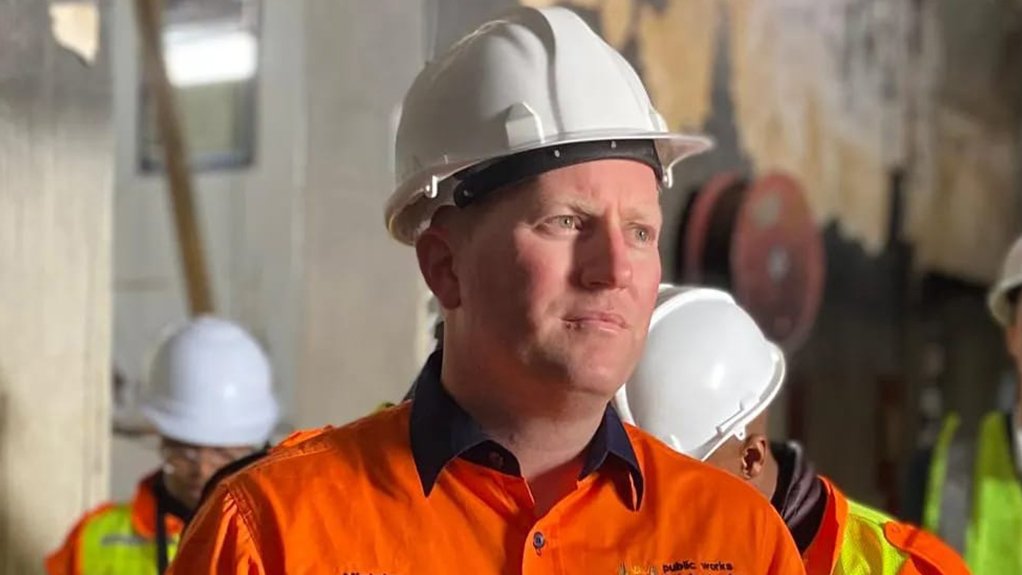



Public Works and Infrastructure Minister Dean Macpherson has confirmed that the Integrated Social Facilitation Framework (ISFF) that is being developed as a national framework to guide stakeholder engagement in public infrastructure projects across all government spheres will be presented to Cabinet early next year.
With the Department of Public Works and Infrastructure having made a commitment to institutionalise the ISFF, Macpherson said it was encouraging to have all social partners universally support the framework during engagements at the National Economic Development and Labour Council last month.
“We are not just going to release this document into the ether, it will be the foundation for how the State does infrastructure delivery across the country,” Macpherson affirmed.
He added that the ISFF also aimed to champion the professionalisation of social facilitators by recognising it as a registered profession. This means that national, provincial, municipal and other government bodies will have to appoint skilled social facilitators that oversee and manage stakeholder engagement processes in accordance with the ISFF.
It will also be mandatory to have a budget for social facilitation, which will be measured by key performance indicators such as stability, inclusion and satisfaction.
“We see this as a critical risk mitigation strategy to ensure infrastructure projects are driven by competent, credible facilitators that can navigate the complex social dynamics in all parts of our country.”
Macpherson further said that no single institution can implement the ISFF alone; rather, it is dependent on an ecosystem of partners. The Construction Industry Development Board (CIDB), for example, is aligning its contract participation goals and regulatory instruments with the ISFF, to ensure local small business inclusion is not just symbolic but measurable.
In turn, the Infrastructure Technical Assistance Facility (ITAF) – that is based within National Treasury – has been instrumental in supporting the development of the ISFF and will be playing a leading role in building capacity across all spheres of government to implement it.
The ITAF will be providing toolkits and training resources to support implementation of the framework, as well as provide oversight and monitoring to adapt the ISFF, if needed, accordingly.
Macpherson is confident that the ISFF will help get the “social dynamics” right with public infrastructure projects, to not just hear local voices but bring communities on board as co-creators of projects.
This will also help mitigate against extortion and other activities that have plagued the construction sector, if communities are the first line of defence against the construction mafia.
“If people feel they are valued and included, it will protect projects and stop them from being overrun by gangsters,” Macpherson stated, pointing out that, since January, 722 suspects linked to extortion had been identified, with 250 suspects having been arrested and 176 convicted.
Moreover, the Minister deemed the ISFF a commitment on government’s part that, from now on, how things were built would be just as important as what was built. “It means we will engage early and proactively, understand who our stakeholders are, listen and adapt, and create platforms for people to be more involved.”
Machperson said communities, and any stakeholder for that matter, should not be treated as tokens or representatives of entire groups, rather, people should be recognised as individuals that are part of the design and construction process.
MORE VIEWS
Independent Development Trust chairperson Zimbini Hill emphasised that the ISFF would harmonise how government consults and delivers on projects.
“South Africa cannot continue to have fragmented approaches to stakeholder inclusion across provinces or municipalities. We will help strengthen and standardise this social facilitation capability across government,” she stated.
Hill added that if people were genuinely seen and heard, the just energy transition gained real legitimacy.
Municipal Infrastructure Support Agency project management director Nomzamo Mnqeta said public infrastructure projects were too often delayed, abandoned or contested as a result of people feeling unseen or excluded. “Inclusive consultation is no longer a tickbox exercise or a step in the process, but a cornerstone of project success.”
She added that when communities, traditional leaders and government had discussions early at the project initiation phase, then infrastructure stopped being something done “to” people and becomes something done “with” them.
DPWI chief director for social facilitation Molatelo Mohwasa echoed the same sentiment, saying the tickbox approach to stakeholder consultation had undermined infrastructure ambitions by treating communities as an afterthought and a risk to be managed.
“True participation is the antidote – the operationalisation of Macpherson’s vision to turn the exclusionary top-down model to one of co-ownership and co-creation at the outset of projects,” she noted.
For example, government will assess what infrastructure is needed in an area together with communities, rather than letting people know what infrastructure will be built after the decision has already been made to build that infrastructure. Communities will have meaningful impacts on the outcome of projects, which will build trust and shared ownership, Mohwasa said.
Commenting on the social facilitator professionalisation component of the ISFF, South African Council for the Project and Construction Management Professions COO Sindiswa Kweinate said government, including entities such as the CIDB, often had good intentions and good regulations in respect of enterprise development and training.
“However, what is lacking is that champion – that person that can integrate communities in a long-term beneficial way. The ISFF is a way in which government is creating the internalised and institutionalised social facilitation,” she explained.
Kweinate added that there was a lot of work that went into engaging communities and affected stakeholders, with a lot of elements that needed to be catered for. To this end, the ISFF outlined a scope of work for what social facilitators should be doing, including what they should be doing proactively.
World Bank Private Infrastructure Advisory Facility infrastructure specialist Samuel Barr agreed that stakeholders needed to have the genuine ability to influence policy or project design, as well as impact the outcomes.
“Consultation does not necessarily mean consensus. There will always be winners and losers, but as long as people get the opportunity to be empowered through the process to influence the things that affect their daily lives, then true participation can be achieved.”
Besides, Barr pointed out, proactive engagement could solve for the issue of public projects often being done impractically owing to little consideration of specific conditions or needs in a community.
International Budget Partnership country director Albert van Zyl lauded government for moving away from a passive model of participation whereby it "books a hall and waits for people to come, or places an advertisement and waits for responses".
“The State should illicit participation and seek out stakeholders, not just announce an opportunity,” he explained.
For Van Zyl, the ISFF also introduced the aspect of answerability. “The concept of answerability says the State is obligated to report what input was given by way of participation; to explain what was done with that information and explain why it can or cannot be done.”
Article Enquiry
Email Article
Save Article
Feedback
To advertise email advertising@creamermedia.co.za or click here


Projects


Latest Multimedia


Latest News

Showroom
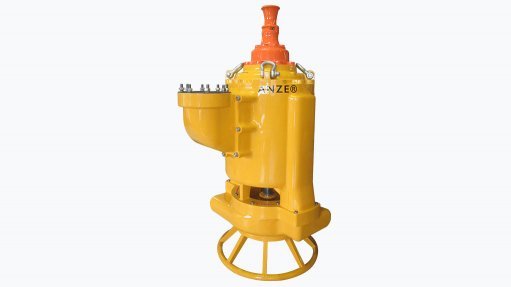
Goodwin Submersible Pumps Africa is sole distributors for Goodwin electrically driven, submersible, abrasion resistance slurry pumps.
VISIT SHOWROOM
ROSOND provides fast, efficient, safe, and cost-effective drilling and grouting services to mining and exploration industries throughout Africa.
VISIT SHOWROOM



Press Office
Announcements
What's On
Subscribe to improve your user experience...
Option 1 (equivalent of R125 a month):
Receive a weekly copy of Creamer Media's Engineering News & Mining Weekly magazine
(print copy for those in South Africa and e-magazine for those outside of South Africa)
Receive daily email newsletters
Access to full search results
Access archive of magazine back copies
Access to Projects in Progress
Access to ONE Research Report of your choice in PDF format
Option 2 (equivalent of R375 a month):
All benefits from Option 1
PLUS
Access to Creamer Media's Research Channel Africa for ALL Research Reports, in PDF format, on various industrial and mining sectors
including Electricity; Water; Energy Transition; Hydrogen; Roads, Rail and Ports; Coal; Gold; Platinum; Battery Metals; etc.
Already a subscriber?
Forgotten your password?
Receive weekly copy of Creamer Media's Engineering News & Mining Weekly magazine (print copy for those in South Africa and e-magazine for those outside of South Africa)
➕
Recieve daily email newsletters
➕
Access to full search results
➕
Access archive of magazine back copies
➕
Access to Projects in Progress
➕
Access to ONE Research Report of your choice in PDF format
RESEARCH CHANNEL AFRICA
R4500 (equivalent of R375 a month)
SUBSCRIBEAll benefits from Option 1
➕
Access to Creamer Media's Research Channel Africa for ALL Research Reports on various industrial and mining sectors, in PDF format, including on:
Electricity
➕
Water
➕
Energy Transition
➕
Hydrogen
➕
Roads, Rail and Ports
➕
Coal
➕
Gold
➕
Platinum
➕
Battery Metals
➕
etc.
Receive all benefits from Option 1 or Option 2 delivered to numerous people at your company
➕
Multiple User names and Passwords for simultaneous log-ins
➕
Intranet integration access to all in your organisation