Lower-emission technologies gain traction

MACROECONOMIC CONDITIONS Equipment demand has become a lot more sensitive to macroeconomic conditions, particularly at ports and terminals.


South Africa’s capital equipment industry is undergoing a shift toward flexible procurement, life-cycle optimisation and lower-emission technologies as industrial sites respond to economic pressure and decarbonisation requirements, explains capital equipment supplier Heavy Lift, a division of CFAO Equipment.
Heavy Lift national product specialist Lenny Naidoo explains that the company operates across South Africa, suppling ship container lifting equipment, warehousing materials handling equipment and air-cargo handling equipment, representing original-equipment manufacturers such as Konecranes, Terberg and Link-Belt Cranes, while supporting customers through new and preowned equipment sales, rentals, maintenance, training, parts supply and fleet support.
Within this environment, Naidoo notes that equipment demand has become a lot more sensitive to macroeconomic conditions, particularly at ports and terminals.
“Terminal operators align their equipment needs with the economy and market demands. When the market flexes, the terminal manager aligns accordingly. We noticed higher demands when the economy starts taking off, and a decline when the economy slows,” he says.
This economic responsiveness is directly affecting how customers procure equipment, with flexibility favoured a lot more over outright ownership. Naidoo points out that changes in shipping patterns are supporting this shift, especially with the recent growth in break-bulk cargo. “We have seen the market change in relation to the shipping industry movement. Break bulk has taken off in recent times. Most shipments are done as break bulk,” he explains.
Consequently, rental models are evolving in both scale and duration. “This has led to the rental model move from short- to long-term rental. Operators also adjust their equipment needs to align with long-term projects,” Naidoo adds, noting that sustained project cargo flows are driving longer-term fleet commitments.
Even where capital expenditure is constrained, he notes that customers are reprioritising investment.
“Terminals look at upgrading their fleet in line with budgets and available capital expenditure. New projects also justify investment in new equipment, especially when project cargo is expected over a lengthy period or on a continuous basis,” he explains.
Along with these procurement shifts, the global green-energy transition is also beginning to have a more material influence on local heavy-lift decisions, especially as pricing dynamics change. Naidoo says that there is a growing interest in electric equipment as cost barriers fall.
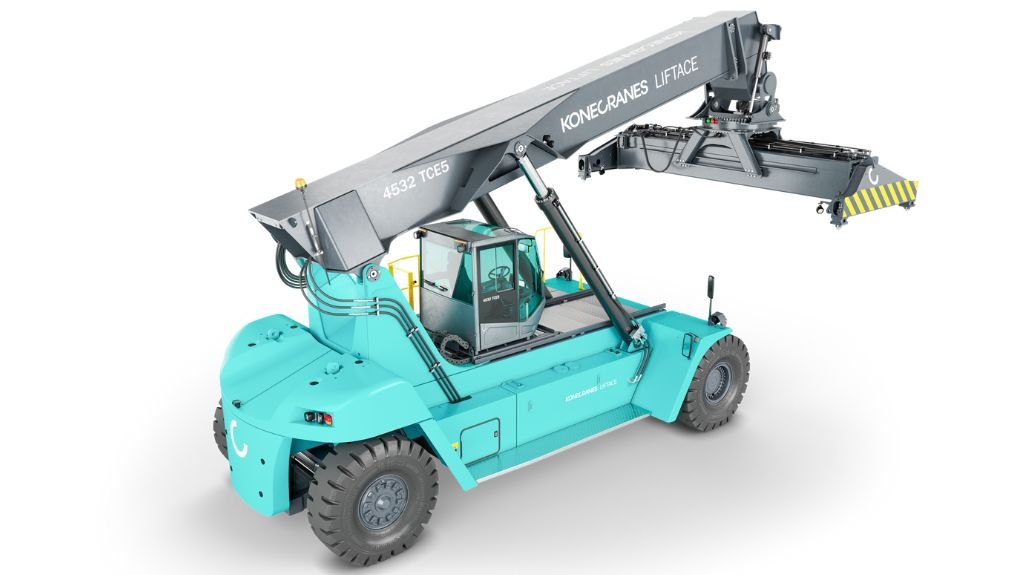
“Now that Konecranes electric reach stackers and empty handlers are extremely well priced relative to the diesel option, terminal operators are looking at going electric sooner than expected,” he says.
Further, while powertrain choices are changing, performance fundamentals remain a priority in purchasing decisions, especially where safety and productivity meet. Naidoo says operator visibility continues to be a key requirement for customers operating in high-traffic terminal environments.
“Customers are always looking for best operator visibility, as this ensures depots continue maintaining high levels of safety,” he notes.
Cab design is therefore becoming an increasingly important differentiator. Naidoo points to Konecranes’ Optima cabin as an example.
“When you step inside an Optima cabin, it is outstandingly spacious and offers superior visibility. That makes operating the lift truck safe and efficient,” he says. He adds that the operator’s cabin can be customised for specific tasks, including control layouts, steering options and adjustable cab height.
Digitalisation is also playing a growing role in supporting uptime and operational efficiency. Naidoo explains that live monitoring is offered across Konecranes lift trucks through its TruConnect system. “Using this fleet management system, terminal operators can manage their fleet, plan their services, monitor uptime on every unit, monitor driver habits, and manage fleet use,” he says.
These digital capabilities show a broader move toward bundled service and availability- focused contracts. “The majority of Heavy Lift customers prefer long-term rental using the maintenance option. This gives terminal operator peace of mind, knowing that their equipment is serviced on time, units are inspected frequently, and preventive maintenance is carried out when required,”
Supporting this model requires careful service planning and parts availability. Naidoo says Heavy Lift’s spare parts team continuously assesses stock levels and aligns inventory with fleet size and operating intensity. Forward planning, he concludes, is key to ensuring major repairs are completed quickly and operational disruption is kept to a minimum.
Article Enquiry
Email Article
Save Article
Feedback
To advertise email advertising@creamermedia.co.za or click here
Research Reports
Projects
Latest Multimedia
Latest News
Showroom
For over 30 years, Werner South Africa Pumps & Equipment (PTY) LTD has been designing, manufacturing, supplying and maintaining specialist...
VISIT SHOWROOM
Occupational health services, mobile clinics, wellness campaigns, aviation.
VISIT SHOWROOM

Press Office
Announcements
What's On
Subscribe to improve your user experience...
Option 1 (equivalent of R125 a month):
Receive a weekly copy of Creamer Media's Engineering News & Mining Weekly magazine
(print copy for those in South Africa and e-magazine for those outside of South Africa)
Receive daily email newsletters
Access to full search results
Access archive of magazine back copies
Access to Projects in Progress
Access to ONE Research Report of your choice in PDF format
Option 2 (equivalent of R375 a month):
All benefits from Option 1
PLUS
Access to Creamer Media's Research Channel Africa for ALL Research Reports, in PDF format, on various industrial and mining sectors
including Electricity; Water; Energy Transition; Hydrogen; Roads, Rail and Ports; Coal; Gold; Platinum; Battery Metals; etc.
Already a subscriber?
Forgotten your password?
Receive weekly copy of Creamer Media's Engineering News & Mining Weekly magazine (print copy for those in South Africa and e-magazine for those outside of South Africa)
➕
Recieve daily email newsletters
➕
Access to full search results
➕
Access archive of magazine back copies
➕
Access to Projects in Progress
➕
Access to ONE Research Report of your choice in PDF format
RESEARCH CHANNEL AFRICA
R4500 (equivalent of R375 a month)
SUBSCRIBEAll benefits from Option 1
➕
Access to Creamer Media's Research Channel Africa for ALL Research Reports on various industrial and mining sectors, in PDF format, including on:
Electricity
➕
Water
➕
Energy Transition
➕
Hydrogen
➕
Roads, Rail and Ports
➕
Coal
➕
Gold
➕
Platinum
➕
Battery Metals
➕
etc.
Receive all benefits from Option 1 or Option 2 delivered to numerous people at your company
➕
Multiple User names and Passwords for simultaneous log-ins
➕
Intranet integration access to all in your organisation