Report labels unbundling of Eskom as ‘most important economic reform since 1994'



A new report commissioned by the South African Energy Traders Association (SAETA) identifies the unbundling of Eskom Holdings as the most important economic reform since 1994, arguing that a new competitive electricity sector construct is required to attract the capital needed to deliver security of supply and affordability.
Titled ‘Policy to power: 10 actions to deliver green, accessible and secure electricity’ the SAETA report has been produced by research and consulting firm Krutham. SAETA itself represents electricity traders and its members include Africa GreenCo, Apollo, Discovery Green, Enpower Trading, Envusa, Etana, EXSA, Investec, Lyra Energy, Mainstream, NOA, POWERX and Sturdee Energy.
The report’s release follows President Cyril Ramaphosa’s recent direct intervention in Eskom’s unbundling process, when he used his State of the Nation Address (SoNA) to overturn an Eskom unbundling plan unveiled in December and which was also endorsed by Electricity and Energy Minister Dr Kgosientsho Ramokgopa.
The unbundling announcement took other parts of government and organised business by surprise in stating that the transmission assets would not be transferred to a new independent and State-owned Transmission System Operator (TSO), but would instead be retained by an Eskom Holdings subsidiary in the form of the National Transmission Company South Africa.
The move led to concerns that Eskom was pursuing a restructuring model that was not in line with the economic-reform commitments made under Operation Vulindlela; reforms that envisage a transition to a competitive electricity supply industry in order to derisk a sector that, under its prevailing monopoly structure, has experienced years of debilitating loadshedding, tariff surges that have made several sectors uncompetitive and costly misgovernance and corruption.
In his SoNA speech, Ramaphosa insisted that the TSO would have ownership and control of transmission assets and be responsible for operating the electricity market. He also announced a dedicated task team under the National Energy Crisis Committee to address various issues relating to the restructuring process and gave it three months to report back with clear time frames and a phased implementation plan.
In response, Eskom said it fully supported the task team that was being created to deliver the TSO.
The SAETA report argues that, if executed efficiently and timeously, Eskom’s unbundling will enable competition, crowd-in private capital and support a resilient power system.
“It will facilitate the establishment of a wholesale electricity market, encouraging competition, enabling trading among many participants and providing the foundation for an electricity multi-market.”
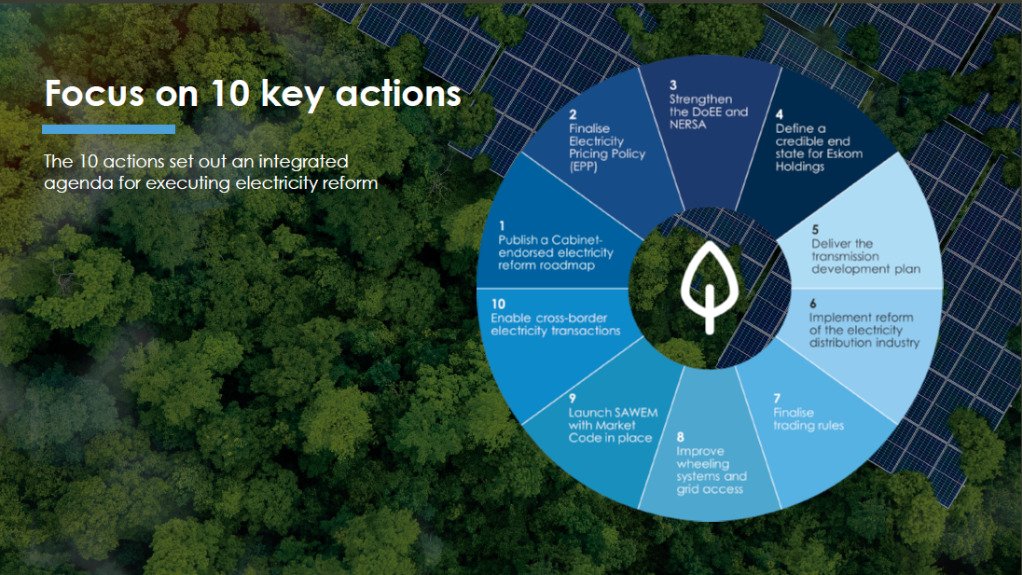
The unbundling of Eskom Holdings has, thus, been included as one of ten priority actions that the report describes as the “minimum set of decisions and deliverables required to move from policy and legislation to a functioning electricity multi-market”.
REFORM ROADMAP
The first action identified, however, is for a Cabinet-endorsed electricity reform roadmap that sets out the intended market target state, key milestones and institutional responsibilities.
“The roadmap should bring together existing reform strands under the Electricity Regulation Amendment Act including the establishment of the South Africa Wholesale Electricity Market, Eskom Holdings’ unbundling and reform of pricing and the distribution industry.
“Clear targets, sequencing and accountability, backed by political authority, are essential to maintain momentum, reduce uncertainty and give investors confidence as reforms move into a more complex execution phase,” the report states.
Speaking during the launch of the report NOA head of trading and co-founder Andrew Taylor said that SAETA recognised that there was no shortage of plans or policies. However, the absence of a coordinated roadmap was resulting in a fragmented and confidence-eroding environment.
“South Africa has made progress, but the window is narrow. Reform is not self-executing. It requires active intervention, political backing, and disciplined delivery.
“The opportunity is substantial: lower-cost power, cleaner electricity, stronger growth, and reduced pressure on the public balance sheet. The cost of delay is equally clear.
“The direction is right. Now is the time to move faster, with clarity and purpose, to unlock the benefits for households, businesses, and the economy,” Taylor said.
The other nine priority actions listed in the report, include:
- Finalising the Electricity Pricing Policy to underpin cost-reflective, unbundled tariffs and bankable contracts;
- Strengthening the Department of Electricity and Energy and the National Energy Regulator of South Africa with skills, resources and clear mandates;
- Defining a credible end state and timeline for Eskom Holdings, including separation of commercial interests and a sustainable balance sheet path;
- Delivering the transmission development plan to unlock grid capacity and non-discriminatory access;
- Implementing reform of the electricity distribution industry, with targeted municipal support for wheeling and systems;
- Finalising trading rules that recognise traders as independent participants and operate in parallel with the Market Code;
- Improving wheeling systems and grid access, including automated, technology-enabled settlement across municipal networks;
- Launching the South African Wholesale Electricity Market (SAWEM) with the Market Code in place, operating coherently alongside bilateral trading; and
- Enabling cross-border electricity transactions to deepen liquidity and strengthen regional security of supply.
Also speaking at the launch, SAETA chairperson Khaya Mbatha, who is head of operations at licensed electricity trader POWERX, said that the reforms would enable electricity traders to play a material role in the transition to a competitive electricity market that was supportive of the economy as a whole.
“They connect generators, customers, financiers and networks, manage risk across time horizons and help projects reach financial close.
“Traders are already demonstrating early, real-world impact, and as the SAWEM comes into operation, their role and impact will grow,” Mbatha said.
Article Enquiry
Email Article
Save Article
Feedback
To advertise email advertising@creamermedia.co.za or click here
Research Reports

Projects
Latest Multimedia
Latest News
Showroom
Your global lifecycle technology & service partner for materials & minerals processing equipment for coal, iron ore, copper, manganese & other...
VISIT SHOWROOM
Stewarts & Lloyds is a leading steel, tube, and engineering product supplier in South Africa.
VISIT SHOWROOM

Announcements
What's On
Subscribe to improve your user experience...
Option 1 (equivalent of R125 a month):
Receive a weekly copy of Creamer Media's Engineering News & Mining Weekly magazine
(print copy for those in South Africa and e-magazine for those outside of South Africa)
Receive daily email newsletters
Access to full search results
Access archive of magazine back copies
Access to Projects in Progress
Access to ONE Research Report of your choice in PDF format
Option 2 (equivalent of R375 a month):
All benefits from Option 1
PLUS
Access to Creamer Media's Research Channel Africa for ALL Research Reports, in PDF format, on various industrial and mining sectors
including Electricity; Water; Energy Transition; Hydrogen; Roads, Rail and Ports; Coal; Gold; Platinum; Battery Metals; etc.
Already a subscriber?
Forgotten your password?
Receive weekly copy of Creamer Media's Engineering News & Mining Weekly magazine (print copy for those in South Africa and e-magazine for those outside of South Africa)
➕
Recieve daily email newsletters
➕
Access to full search results
➕
Access archive of magazine back copies
➕
Access to Projects in Progress
➕
Access to ONE Research Report of your choice in PDF format
RESEARCH CHANNEL AFRICA
R4500 (equivalent of R375 a month)
SUBSCRIBEAll benefits from Option 1
➕
Access to Creamer Media's Research Channel Africa for ALL Research Reports on various industrial and mining sectors, in PDF format, including on:
Electricity
➕
Water
➕
Energy Transition
➕
Hydrogen
➕
Roads, Rail and Ports
➕
Coal
➕
Gold
➕
Platinum
➕
Battery Metals
➕
etc.
Receive all benefits from Option 1 or Option 2 delivered to numerous people at your company
➕
Multiple User names and Passwords for simultaneous log-ins
➕
Intranet integration access to all in your organisation