As SA’s auto makers struggle, there is ‘no choice’ but to hike tariffs on vehicle imports

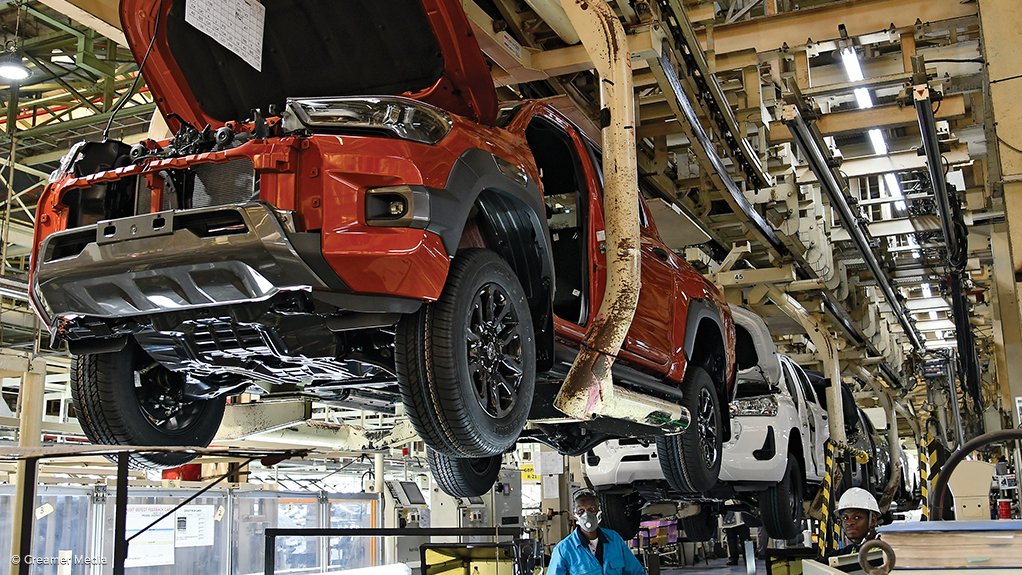


The South African government will have no choice but to impose antidumping duties on imported vehicles, says Trade, Industry and Competition Deputy Minister Zuko Godlimpi.
Godlimpi on Tuesday attended a briefing by his department and other auto industry roleplayers to the parliamentary Portfolio Committee of Trade, Industry and Competition on the implementation of the South African Automotive Masterplan.
When quizzed by portfolio committee members on the impact of rapidly rising imports of completely built-up (CBU) vehicles from India and China on the local automotive industry, he indicated that government would use duties to protect its manufacturing sector.
“We’ll have no choice but to impose antidumping duties against our own allies.
“It is not an affront on the relationship as such, but it is to tactically defend your employment capability in South Africa and the capacity of your industry to weather the storms – the storms being the general disruption of the auto sector globally – until we are in a position to produce new energy vehicles (NEVs) competitively and maintain a degree of internal combustion engine (ICE) [production].”
International Trade Administration Commission of South Africa chief commissioner Ayabonga Cawe indicated that South Africa did “have room to manoeuvre” within its concessions to the World Trade Organisation (WTO).
For CBU imported passenger vehicles, South Africa’s bound rates were at 50%, with the current duties imposed under government’s Automotive Production and Development Programme (APDP) set at around 25%, he noted.
“On components, you also have room to manoeuvre, depending on the origin market, of anywhere between 10% and 12%.”
A bound rate is the maximum legally committed tariff rate a WTO member country has agreed to impose on imports of a specific product.
South Africa was hard at work in its attempts to convince especially Chinese car makers to establish manufacturing operations in South Africa, added Godlimpi, noting that government wanted to add to the country’s tally of seven assembly plants, instead of replacing or losing any existing plants.
The automotive industry, South Africa’s biggest manufacturing sector, on Tuesday painted a rather bleak picture of its future should government not come to its assistance.
National Association of Automotive Component and Allied Manufacturers (Naacam) CEO Renai Moothilal described government’s auto sector support programme – the APDP – as “stuck in the mud”.
In 2024, vehicle imports from China made up 22% of all vehicle imports to the country (up 368% from 2020), with 53% (up 135% from 2020) coming from India. (A number of well-known brands that are not from India, assemble some of their models in that country, such as Toyota, Suzuki and Hyundai.)
Moothilal lamented the fact that European and American manufacturers had invested in local assembly capacity, but that China and India had failed to followed suit.
The rise in imports meant that local production levels had been stagnating below pre-Covid levels at around 600 000 units a year, with light vehicle production forecast to fall to around 560 000 units a year for this and the next year.
Also, the percentage of locally made parts in these vehicles had been declining by an average of 1.1% a year over the past 25 years, he added.
This and other factors had seen the implementation of short time, retrenchments and plant closures in the component manufacturing sector.
Over the last three years, Naacam had recorded 13 component company closures, said Moothilal, with more expected this year.
Among a raft of potential remedies, he believed that increasing duties on imported vehicles could be implemented immediately, as well as government embracing the preferential procurement of locally made parts and vehicles.
Small Local Market; Big Problems
Toyota South Africa Motors president and CEO Andrew Kirby highlighted in his presentation that the South African domestic new-vehicle market continued to lack scale.
There also remained uncertainty regarding government’s policy to support the shift in local production from ICE vehicles to NEVs.
Kirby is also the manufacturing VP of industry body naamsa | the Automotive Business Council.
naamsa president and BMW Group South Africa CEO Peter van Binsbergen emphasised that South Africa had become a market that continued to see locally produced vehicles being squeezed out in favour of imported vehicles, with one in three new vehicles sold now made in South Africa, as opposed to the previous tally of two in three.
According to Van Binsbergen, the auto industry was also left vulnerable by the over-reliance on a single export market that absorbed 80% of its new-vehicle exports – the UK-EU combined market.
This market was, however, in the midst of a rapid change-over to NEVs, while South Africa still largely produced ICE vehicles.
One way to help balance the books in favour of the local manufacturing industry would be to grow the local market as it could then absorb more of the vehicles made in-country, he suggested.
On this front, the price tag of new cars presented a significant challenge – more so as vehicle importers have, by now, largely cornered the volume entry-level segment.
Kirby’s presentation indicated that entry-level car prices in South Africa have tripled over the past 20 years owing to the weaker rand, inflation, and higher vehicle standards and costs.
Godlimpi noted that Chinese vehicle makers were equally concerned about the size of the domestic market – in their case the fact that it lacked the scale to justify opening an assembly plant.
One solution, he said, was to invite Chinese car makers to look at the broader African market as their marketplace, especially as presented under the African Continental Free Trade Area Agreement, when considering local production.
He added that the Department of Trade, Industry and Competition (dtic) was in discussions with National Treasury around current new-vehicle taxes and how restructuring these costs could bring relief to car buyers – thereby potentially growing the local market.
The focus was on the ad valorem (luxury) tax currently levied on new-vehicle sales. However, this relief might largely be targeted at stimulating local production, rather than providing a blanket boost to the entire industry.
Slow-moving Policy Review; Battery Policy on its Way
The dtic acknowledged in its presentation that the work underway – through a review of the APDP – to mitigate the raft of current challenges facing the auto sector had “been a bit slow”.
“Hence, currently, we are taking a multipronged approach…whilst there will be an overall comprehensive review, we are taking certain elements in parallel to look into.
“We are looking specifically on how we can turn the tide on localisation. We are finalising a proposal for consideration by our Ministers – in this regard we should have a final proposal before the end of February.
“Some elements will be quick; others might need some time for implementation. These would cover a variety of issues, including tariffs; including some elements of the structure of the [APDP] so that it encourages increasing localisation."
“And, lastly, we are looking at the tax side of things. There are ideas around how we can use that instrument to support localisation, from trying to deal with ad valorem tax, reviewing its formula, and perhaps a better utilisation thereof in a manner that supports local production.
“On the EV White Paper, implementation is ongoing,” noted the dtic.
“Some of the elements to support local production should be coming online from March this year. Some of the elements are under development for implementation.
“But also, we are revisiting it to include hybrids, which were not previously included.”
A Battery Manufacturing Policy is also being developed.
“We hope to have a proposal ready by the end of March,” said dtic officials.
Article Enquiry
Email Article
Save Article
Feedback
To advertise email advertising@creamermedia.co.za or click here
Research Reports

Projects

Latest Multimedia
Latest News

Showroom
Astore Keymak is one of South Africa’s leading suppliers of high-quality Thermoplastic Pipeline Systems, with branches in the major provinces.
VISIT SHOWROOM
Supplier & Distributor of the Widest Range of Accurate & Easy-to-Use Alcohol Breathalysers
VISIT SHOWROOM

Announcements
What's On
Subscribe to improve your user experience...
Option 1 (equivalent of R125 a month):
Receive a weekly copy of Creamer Media's Engineering News & Mining Weekly magazine
(print copy for those in South Africa and e-magazine for those outside of South Africa)
Receive daily email newsletters
Access to full search results
Access archive of magazine back copies
Access to Projects in Progress
Access to ONE Research Report of your choice in PDF format
Option 2 (equivalent of R375 a month):
All benefits from Option 1
PLUS
Access to Creamer Media's Research Channel Africa for ALL Research Reports, in PDF format, on various industrial and mining sectors
including Electricity; Water; Energy Transition; Hydrogen; Roads, Rail and Ports; Coal; Gold; Platinum; Battery Metals; etc.
Already a subscriber?
Forgotten your password?
Receive weekly copy of Creamer Media's Engineering News & Mining Weekly magazine (print copy for those in South Africa and e-magazine for those outside of South Africa)
➕
Recieve daily email newsletters
➕
Access to full search results
➕
Access archive of magazine back copies
➕
Access to Projects in Progress
➕
Access to ONE Research Report of your choice in PDF format
RESEARCH CHANNEL AFRICA
R4500 (equivalent of R375 a month)
SUBSCRIBEAll benefits from Option 1
➕
Access to Creamer Media's Research Channel Africa for ALL Research Reports on various industrial and mining sectors, in PDF format, including on:
Electricity
➕
Water
➕
Energy Transition
➕
Hydrogen
➕
Roads, Rail and Ports
➕
Coal
➕
Gold
➕
Platinum
➕
Battery Metals
➕
etc.
Receive all benefits from Option 1 or Option 2 delivered to numerous people at your company
➕
Multiple User names and Passwords for simultaneous log-ins
➕
Intranet integration access to all in your organisation