Global supply chains enter era of structural volatility – WEF


Global value chains have entered an era of structural volatility and nearly three in four business leaders now prioritise resilience investments, with 74% viewing resilience as a driver of growth, says international finance organisation the World Economic Fund (WEF).
This is forcing companies and governments to reevaluate how and where they invest and produce, the WEF 'Global Value Chains Outlook 2026: Orchestrating Corporate and National Agility' report states.
Set against a backdrop of geopolitical fragmentation, accelerating technological change and mounting resource constraints, disruption becomes a permanent feature rather than a cyclical shock. The volatility reflects a fundamental rewiring of global value chains, driven by geopolitics, industrial policy, the energy transition and technological acceleration.
“Volatility is no longer a temporary disruption; it is a structural condition leaders must plan for. Competitive advantage now comes from foresight, optionality and ecosystem coordination. Companies and countries that build these capabilities together will be best positioned to attract investment, secure supply and sustain growth in an increasingly fragmented global economy,” says WEF MD Kiva Allgood.
The scale of the shift is evident. In 2025, tariff escalations between major economies reshuffled more than $400-billion in global trade flows, while disruptions across major shipping routes pushed container shipping costs up 40% year-on-year, signalling a decisive move away from short-term shocks towards enduring uncertainty.
Simultaneously, manufacturing output across advanced economies is growing at its weakest pace since 2009, while more than 3 000 new trade and industrial policy measures were introduced globally in 2025, which is more than three times the yearly level recorded a decade ago.
These underscore why supply chain resilience has become a central determinant of national competitiveness and corporate strategy, the WEF says.
Additionally, targeted national approaches are already shaping manufacturing competitiveness.
In Ireland, enterprise-led upskilling through Skillnet Ireland links government, business and educators to deliver subsidised training aligned with industry needs, while in China, large-scale investment in digital infrastructure under the New Infrastructure initiative has enabled real-time industrial connectivity through widespread 5G deployment.
In Qatar, a national dashboard tracking essential food items in real-time strengthens supply security by enabling early intervention, buffer stocks and rapid, data-driven responses to disruption, the report shows.
The report sets out a dual way forward, namely by defining strategic imperatives for industry and a blueprint for industrial policy, and developing a complementary interactive tool helps businesses and governments assess manufacturing risks, strengths and gaps.
“Supply chain disruption in 2026 will be constant and structural. Geopolitical fragmentation, shifting trade rules and labour shortages are all redefining how value is created and moved,” says management consulting firm Kearney partner Per Kristian Hong.
“For supply leaders, the priority is no longer forecasting disruption, but redesigning operating models to function under permanent uncertainty. This means moving away from efficiency-driven supply chains and towards adaptive networks that can be reconfigured with optionality as conditions change,” he says.
Article Enquiry
Email Article
Save Article
Feedback
To advertise email advertising@creamermedia.co.za or click here

Projects
Latest Multimedia

Latest News


Showroom
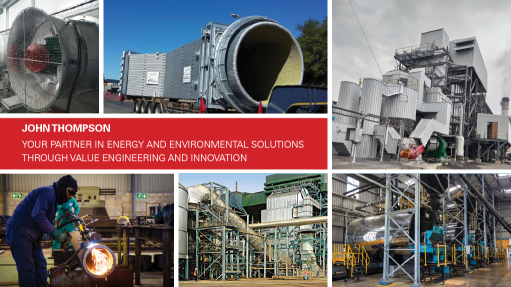
John Thompson, the leader in energy and environmental solutions through value engineering and innovation, provides the following: design, engineer,...
VISIT SHOWROOM
Complete range of security sealing solutions including security seals bags and labels.
VISIT SHOWROOM


Press Office
Announcements
What's On
Subscribe to improve your user experience...
Option 1 (equivalent of R125 a month):
Receive a weekly copy of Creamer Media's Engineering News & Mining Weekly magazine
(print copy for those in South Africa and e-magazine for those outside of South Africa)
Receive daily email newsletters
Access to full search results
Access archive of magazine back copies
Access to Projects in Progress
Access to ONE Research Report of your choice in PDF format
Option 2 (equivalent of R375 a month):
All benefits from Option 1
PLUS
Access to Creamer Media's Research Channel Africa for ALL Research Reports, in PDF format, on various industrial and mining sectors
including Electricity; Water; Energy Transition; Hydrogen; Roads, Rail and Ports; Coal; Gold; Platinum; Battery Metals; etc.
Already a subscriber?
Forgotten your password?
Receive weekly copy of Creamer Media's Engineering News & Mining Weekly magazine (print copy for those in South Africa and e-magazine for those outside of South Africa)
➕
Recieve daily email newsletters
➕
Access to full search results
➕
Access archive of magazine back copies
➕
Access to Projects in Progress
➕
Access to ONE Research Report of your choice in PDF format
RESEARCH CHANNEL AFRICA
R4500 (equivalent of R375 a month)
SUBSCRIBEAll benefits from Option 1
➕
Access to Creamer Media's Research Channel Africa for ALL Research Reports on various industrial and mining sectors, in PDF format, including on:
Electricity
➕
Water
➕
Energy Transition
➕
Hydrogen
➕
Roads, Rail and Ports
➕
Coal
➕
Gold
➕
Platinum
➕
Battery Metals
➕
etc.
Receive all benefits from Option 1 or Option 2 delivered to numerous people at your company
➕
Multiple User names and Passwords for simultaneous log-ins
➕
Intranet integration access to all in your organisation