How digital infrastructure design choices will decide who wins in AI





This article has been supplied.
By: Canninah Dladla - Cluster President for English-speaking Africa at Schneider Electric
As AI drives continues to disrupt industries across the world, the race is no longer just about smarter models or better data. It’s about building infrastructure powerful enough to support innovation at scale. Staying competitive therefore demands more than incremental upgrades; it requires a forward-looking strategy built to handle today’s intensity and tomorrow’s unknowns.
Organisations that treat digital infrastructure as a strategic business investment are setting the pace. And decisions around energy efficiency, improved thermal management, and modular design are directly influencing AI performance, speed to market, operational cost, and ultimately long-term competitiveness.
The strategic imperative
Historically, power and cooling sat firmly in the “necessary expense” category, essential to maintain but rarely viewed as a source of competitive advantage. That reality has changed. Infrastructure now directly affects AI workload performance, deployment timelines, sustainability targets, and overall business value.
The numbers don’t lie. In 2025, leading technology companies, including Meta, Amazon, Alphabet, and Microsoft, are projected to invest a record $320 billion in AI infrastructure and data centers. This represents a 65% increase from the previous year, with 60% of the investment allocated specifically to data center expansion.
This unparalleled spending underscores the industry's recognition of AI infrastructure as a fundamental business necessity rather than a basic operational concern.
The spotlight on thermal management
As operators race to optimise infrastructure, thermal management has become one of the most urgent priorities. AI compute intensity is pushing rack power densities well beyond traditional thresholds.
Indeed, some AI-optimised facilities are expected to exceed 140 kW per rack by the second half of 2025; a clear indicator that previous cooling methods are no longer sufficient.
Liquid cooling has moved from an “emerging trend” to “unavoidable necessity”. It enables far higher compute density while reducing energy consumption and operational costs.
However, adopting liquid cooling also introduces new operational complexities, requiring highly coordinated control systems, specialised expertise, and precision engineering. As rack densities continue to rise, the margin for error shrinks. This makes experienced partners essential to help organisations scale safely and efficiently.
Availability and efficiency
AI workloads demand vast, uninterrupted power delivery. To ensure resilience and sustainability, data centres must embrace energy-efficient designs and establish close partnerships with utilities to integrate renewable energy sources and smart grid technologies.
Partnerships are proving critical in meeting these requirements. One example is the collaboration between Schneider Electric and NVIDIA, focused on AI-optimised data centre reference architectures capable of supporting server racks consuming up to 142 kW, incorporating liquid cooling technologies to reduce cooling energy consumption and accelerate deployment.
Modularity and speed
AI development cycles continue to accelerate which means infrastructure must match that pace or risk bottlenecks. Modular, prefabricated, and scalable architectures are emerging as core enablers for high-density deployments, allowing data centre operators to build, expand, and standardise rapidly and efficiently.
The reality is conventional data center construction often requires 18 to 24 months, but modular, standardised infrastructure is compressing that timeline, enabling fully commissioned facilities in as little as seven months.
With these time savings, it’s no surprise that the global modular data center market is developing fast with MarketsandMarkets projecting growth from $29.9 billion in 2024 to nearly $79.5 billion by 2030.
Continue to innovate
Forward-thinking business leaders who treat digital infrastructure as a long-term strategic investment are setting themselves up for greater agility, cost efficiency, and resilience.
To stay ahead, data centre operators and enterprise decision-makers must recognise that gaining a competitive edge requires a relentless focus on innovation to navigate the ever-evolving, ever-increasing demands of AI. It takes technical expertise, trusted partnerships, and a willingness to adopt bold, cutting-edge technologies.
Schneider Electric is answering that call with a new generation of integrated, scalable solutionsdesigned for AI. From high-density power distribution to advanced thermal management and intelligent pod and rack configurations, these solutions are built to speed up deployment and drive operational efficiencies.
Ultimately, by aligning with forward-thinking partners like Schneider Electric, organisations can stay on the cutting edge of innovation and better position themselves to win the AI race.
Article Enquiry
Email Article
Save Article
Feedback
To advertise email advertising@creamermedia.co.za or click here
Research Reports

Projects

Latest Multimedia

Latest News


Showroom

Rio Carb is an OEM (Original Equipment Manufacturer) of R-C700 Chromium Carbide (CrC) alloy clad wear plates and pipes used for heavy materials...
VISIT SHOWROOM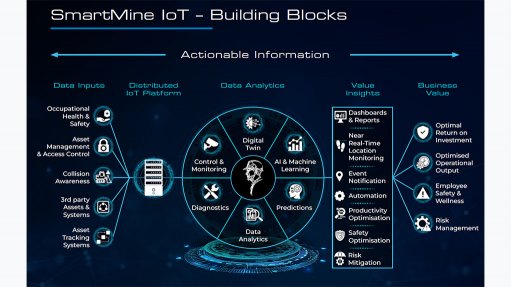
SmartMine IoT has been developed with the mining industry in mind, to provides our customers with powerful business intelligence and data modelling...
VISIT SHOWROOM


Press Office
Announcements
What's On
Subscribe to improve your user experience...
Option 1 (equivalent of R125 a month):
Receive a weekly copy of Creamer Media's Engineering News & Mining Weekly magazine
(print copy for those in South Africa and e-magazine for those outside of South Africa)
Receive daily email newsletters
Access to full search results
Access archive of magazine back copies
Access to Projects in Progress
Access to ONE Research Report of your choice in PDF format
Option 2 (equivalent of R375 a month):
All benefits from Option 1
PLUS
Access to Creamer Media's Research Channel Africa for ALL Research Reports, in PDF format, on various industrial and mining sectors
including Electricity; Water; Energy Transition; Hydrogen; Roads, Rail and Ports; Coal; Gold; Platinum; Battery Metals; etc.
Already a subscriber?
Forgotten your password?
Receive weekly copy of Creamer Media's Engineering News & Mining Weekly magazine (print copy for those in South Africa and e-magazine for those outside of South Africa)
➕
Recieve daily email newsletters
➕
Access to full search results
➕
Access archive of magazine back copies
➕
Access to Projects in Progress
➕
Access to ONE Research Report of your choice in PDF format
RESEARCH CHANNEL AFRICA
R4500 (equivalent of R375 a month)
SUBSCRIBEAll benefits from Option 1
➕
Access to Creamer Media's Research Channel Africa for ALL Research Reports on various industrial and mining sectors, in PDF format, including on:
Electricity
➕
Water
➕
Energy Transition
➕
Hydrogen
➕
Roads, Rail and Ports
➕
Coal
➕
Gold
➕
Platinum
➕
Battery Metals
➕
etc.
Receive all benefits from Option 1 or Option 2 delivered to numerous people at your company
➕
Multiple User names and Passwords for simultaneous log-ins
➕
Intranet integration access to all in your organisation