IATA cuts 2025 SAF forecast, warns EU, UK mandates stalling progress

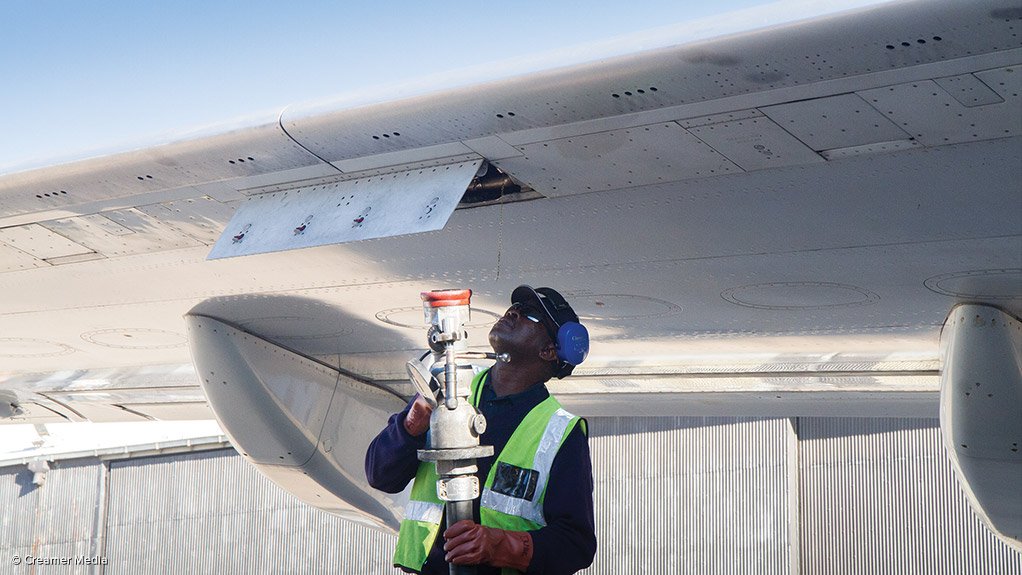


The International Air Transport Association (IATA) has lowered its forecast for global sustainable aviation fuel (SAF) production for this year, stating that government mandates in the EU and the UK have pushed up prices, restricted supply and slowed the industry’s progress towards reducing emissions.
IATA said new estimates show that SAF output is expected to reach 1.9-million tonnes, or about 2.4-billion litres, this year, which is nearly double the one-million tonnes produced in 2024 but below earlier expectations.
The organisation said on December 9 that production growth is projected to slow further next year, when output is expected to reach 2.4-million tonnes. According to IATA, the 2025 volume will account for just 0.6% of total jet fuel consumption, increasing only slightly to 0.8% in 2026.
IATA said current market prices mean the premium on SAF will translate into an additional $3.6-billion in fuel costs for the airline industry this year.
The organisation added that its revised forecast for this year reflects weaker policy support, which has prevented companies from making full use of installed production capacity. IATA said SAF prices remain two to five times higher than conventional jet fuel, depending on the market.
“SAF production growth fell short of expectations as poorly designed mandates stalled momentum in the fledgling SAF industry. If the goal of SAF mandates was to slow progress and increase prices, policymakers knocked it out of the park.
“But if the objective is to increase SAF production to further the decarbonisation of aviation, then they need to learn from failure and work with the airline industry to design incentives that will work,” IATA director general Willie Walsh said.
The association said mandates in the EU and the UK have increased costs without expanding supply. It said the ReFuelEU Aviation rules have sharply raised prices owing to limited SAF capacity and an oligopolistic supply chain, with fuel suppliers widening their margins to the point that airlines are paying up to five times more than conventional jet fuel and double the market price of SAF.
IATA said this situation has occurred without guaranteed supply or consistent documentation. It added that the UK’s mandate has also driven price spikes, leaving airlines to absorb higher costs.
According to IATA, airlines paid a premium of $2.9-billion for the limited 1.9-million tonnes of SAF available this year. Of this amount, $1.4-billion reflects the typical price gap between SAF and standard jet fuel.
“Europe’s fragmented policies distort markets, slow investment and undermine efforts to scale SAF production. Europe’s regulators must recognise that its approach is not working and urgently correct course.
“The recent European Commission Sustainable Transport Investment Plan announcement is a step forward though it lacks a clear timeline. Actions, not words, are what matter,” Walsh said.
He added that the constrained growth of SAF will cause many airlines to reassess their own targets.
“Regrettably, many airlines that have committed to use 10% SAF by 2030 will be forced to reevaluate these commitments. SAF is not being produced in sufficient amounts to enable these airlines to achieve their ambition. These commitments were made in good faith but simply cannot be delivered,” Walsh said.
IATA also highlighted upcoming mandates for synthetic e-SAF in the UK in 2028 and in the EU in 2030. The organisation said e-SAF has an even higher cost base, potentially up to 12 times the price of fossil jet fuel and warned that, without stronger production incentives, the supply will fall short of government targets.
It said compliance costs could reach €29-billion by 2032 if targets were missed under the current framework.
“Given the low SAF production volumes, it is evident that current policies are not having the desired effect. Faced with such facts, regulators must course-correct, ensure the long-term viability of SAF production and achieve scale so that costs can come down.
“Mandates have done just the opposite, and it is outrageous to repeat the same mistakes with e-SAF mandates,” IATA chief economist senior VP for sustainability Marie Owens Thomsen said.
Article Enquiry
Email Article
Save Article
Feedback
To advertise email advertising@creamermedia.co.za or click here

Projects

Latest Multimedia

Latest News


Showroom

John Thompson, the leader in energy and environmental solutions through value engineering and innovation, provides the following: design, engineer,...
VISIT SHOWROOM
Complete range of security sealing solutions including security seals bags and labels.
VISIT SHOWROOM



Press Office
Announcements
What's On
Subscribe to improve your user experience...
Option 1 (equivalent of R125 a month):
Receive a weekly copy of Creamer Media's Engineering News & Mining Weekly magazine
(print copy for those in South Africa and e-magazine for those outside of South Africa)
Receive daily email newsletters
Access to full search results
Access archive of magazine back copies
Access to Projects in Progress
Access to ONE Research Report of your choice in PDF format
Option 2 (equivalent of R375 a month):
All benefits from Option 1
PLUS
Access to Creamer Media's Research Channel Africa for ALL Research Reports, in PDF format, on various industrial and mining sectors
including Electricity; Water; Energy Transition; Hydrogen; Roads, Rail and Ports; Coal; Gold; Platinum; Battery Metals; etc.
Already a subscriber?
Forgotten your password?
Receive weekly copy of Creamer Media's Engineering News & Mining Weekly magazine (print copy for those in South Africa and e-magazine for those outside of South Africa)
➕
Recieve daily email newsletters
➕
Access to full search results
➕
Access archive of magazine back copies
➕
Access to Projects in Progress
➕
Access to ONE Research Report of your choice in PDF format
RESEARCH CHANNEL AFRICA
R4500 (equivalent of R375 a month)
SUBSCRIBEAll benefits from Option 1
➕
Access to Creamer Media's Research Channel Africa for ALL Research Reports on various industrial and mining sectors, in PDF format, including on:
Electricity
➕
Water
➕
Energy Transition
➕
Hydrogen
➕
Roads, Rail and Ports
➕
Coal
➕
Gold
➕
Platinum
➕
Battery Metals
➕
etc.
Receive all benefits from Option 1 or Option 2 delivered to numerous people at your company
➕
Multiple User names and Passwords for simultaneous log-ins
➕
Intranet integration access to all in your organisation