Africa must balance ocean conservation, economic growth to unlock blue economy potential

Panelists in a webinar hosted on behalf of Sustainability & ESG Africa Conference explore how African countries can develop a sustainable and inclusive blue economy while protecting fragile marine ecosystems
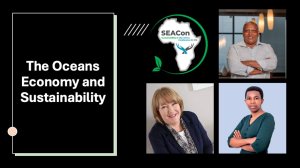


Africa’s oceans economy presents major opportunities for economic growth, food security and energy development, but unlocking this potential will require stronger regional coordination, improved governance and a balance between environmental protection and resource utilisation.
This was among the key themes discussed during a recent webinar on Oceans Economy and Sustainability, which explored how African countries can develop a sustainable and inclusive blue economy while protecting fragile marine ecosystems.
Opening the discussion, moderator Wendy Poulton, co-founder of Sustainability & ESG Africa Conference & Expo, highlighted the scale of the opportunity. Africa has 38 coastal and island States, with ocean-based activities supporting food production, trade, energy and millions of livelihoods across the continent. At the same time, emerging industries – including green shipping fuels such as ammonia and methanol derived from renewable hydrogen – are creating new possibilities for African ports and infrastructure.
However, speakers emphasised that the blue economy must be developed in a way that protects ecosystems and benefits local communities.
African Union (AU) blue economy division senior policy adviser Immaculee Uwimana noted that the concept of a regenerative ocean economy focuses on restoring ecosystems while still generating economic value.
“In practice this means implementing initiatives that reduce pressure on oceans while creating jobs and improving livelihoods,” she said.
Examples include restoring mangrove ecosystems to support blue carbon initiatives, expanding sustainable aquaculture and implementing marine spatial planning to ensure ocean resources are managed within ecological limits.
Such measures are increasingly urgent, she noted, as climate-related water and ocean shocks already cost Africa billions of dollars yearly.
Tackling Illegal Fishing
One of the most pressing challenges for the continent is illegal, unreported and unregulated fishing.
According to figures cited during the webinar, Africa loses about $24-billion a year through illegal fishing activities, depriving countries of income, jobs and food security.
Uwimana stressed that addressing the problem requires an ecosystem-based approach and stronger cooperation among African countries.
“Fish stocks are transboundary, and ocean waters are shared among different countries, so enforcement must be coordinated,” she explained.
The AU is working with regional economic communities to strengthen monitoring systems, harmonise policies and build institutional capacity to combat illegal fishing.
Maritime skills development entity South African International Maritime Institute CEO Odwa Mtati added that inconsistent regulations across countries can create loopholes that illegal operators exploit.
“When something is illegal in one country but not in another, vessels simply move across the boundary,” he said.
He argued that harmonised standards, joint maritime patrols and shared monitoring technologies – including satellite surveillance – could significantly improve enforcement.
Energy Transition Opportunities
The discussion also explored the growing link between the oceans economy and the global energy transition.
Maritime transport currently accounts for around 3% of global greenhouse gas emissions, creating pressure on the shipping sector to decarbonise.
Africa could play an important role in this transition because of its abundant renewable energy resources and strategic location along global shipping routes.
Uwimana said the continent has the potential to become a hub for the production and supply of green fuels for shipping, such as hydrogen-derived ammonia or methanol.
“Africa can transition from being only a transit route for commodities to becoming a refuelling hub for global shipping,” she noted.
However, large-scale fuel production and port expansion also carry environmental risks, including pressure on coastal ecosystems and competition for land and water resources. Strong environmental safeguards and local community benefits must therefore remain central to development plans.
Infrastructure and Skills
Developing the oceans economy will also require investment in infrastructure and human capital.
Mtati said Africa should focus not only on building new ports but on maximising the efficiency of existing infrastructure while planning future developments carefully through marine spatial planning.
At the same time, the sector will require new skills as technologies and industries evolve.
Both speakers emphasised the importance of partnerships between governments, universities and international organisations to develop training programmes covering areas such as maritime governance, renewable energy, marine science and ocean resource management.
Ultimately, participants agreed that Africa’s oceans hold vast potential – but realising it will depend on coordinated policy frameworks, stronger institutions and long-term planning.
“If we work together as a continent and develop our own capabilities, the blue economy can become a powerful driver of sustainable development,” Mtati concluded.
Article Enquiry
Email Article
Save Article
Feedback
To advertise email advertising@creamermedia.co.za or click here

Projects
Latest Multimedia
Latest News


Showroom
CSIR International Convention Centre (CSIR ICC) - the leading conference and events venue in Pretoria/Tshwane.
VISIT SHOWROOM
For over 15 years, Lilak Aluminium, a trusted leader in architectural extrusion supply, has delivered excellence to businesses like yours.
VISIT SHOWROOM
Press Office
Announcements
What's On
Subscribe to improve your user experience...
Option 1 (equivalent of R125 a month):
Receive a weekly copy of Creamer Media's Engineering News & Mining Weekly magazine
(print copy for those in South Africa and e-magazine for those outside of South Africa)
Receive daily email newsletters
Access to full search results
Access archive of magazine back copies
Access to Projects in Progress
Access to ONE Research Report of your choice in PDF format
Option 2 (equivalent of R375 a month):
All benefits from Option 1
PLUS
Access to Creamer Media's Research Channel Africa for ALL Research Reports, in PDF format, on various industrial and mining sectors
including Electricity; Water; Energy Transition; Hydrogen; Roads, Rail and Ports; Coal; Gold; Platinum; Battery Metals; etc.
Already a subscriber?
Forgotten your password?
Receive weekly copy of Creamer Media's Engineering News & Mining Weekly magazine (print copy for those in South Africa and e-magazine for those outside of South Africa)
➕
Recieve daily email newsletters
➕
Access to full search results
➕
Access archive of magazine back copies
➕
Access to Projects in Progress
➕
Access to ONE Research Report of your choice in PDF format
RESEARCH CHANNEL AFRICA
R4500 (equivalent of R375 a month)
SUBSCRIBEAll benefits from Option 1
➕
Access to Creamer Media's Research Channel Africa for ALL Research Reports on various industrial and mining sectors, in PDF format, including on:
Electricity
➕
Water
➕
Energy Transition
➕
Hydrogen
➕
Roads, Rail and Ports
➕
Coal
➕
Gold
➕
Platinum
➕
Battery Metals
➕
etc.
Receive all benefits from Option 1 or Option 2 delivered to numerous people at your company
➕
Multiple User names and Passwords for simultaneous log-ins
➕
Intranet integration access to all in your organisation