Budget 2026: Credibility with Teeth


This article has been supplied.
By: Head of Fixed Income at Prescient Securities - Kristof Kruger
South Africa’s 2026 Budget marks a clear inflection point in fiscal management. For the first time in 17 years, gross debt stabilises — peaking at 78.9% of GDP in 2025/26 before declining to 76.5% by 2028/29. The consolidated deficit narrows from 4.5% this year to 3.1% over the medium term. The primary surplus rises from 0.9% to 2.3%.
For fixed-income investors, the direction of travel is unambiguous: fiscal consolidation is no longer aspirational — it is embedded in the framework.
Revenue resilience has allowed Treasury to withdraw the previously provisioned R20 billion in tax increases. Personal income tax brackets are fully adjusted for inflation. The VAT registration threshold rises from R1 million to R2.3 million. Savings of R12 billion have been identified through expenditure rationalisation rather than additional taxation.
This is fiscal consolidation without austerity theatre.
The Structural Innovation: Conditional Funding with Consequences
The most under-appreciated reform in this Budget is not the deficit path — it is the redesign of intergovernmental fiscal incentives.
Treasury explicitly acknowledges that 63% of municipalities are in financial distress. The response is a R27.7 billion performance-linked reform to metro trading services in water, electricity, sanitation and solid waste. Under the new framework, failure to meet operational and governance targets will result in budget reductions.
Treasury has tried conditional and performance-linked funding before. The difference this time is the explicit budget-reduction clause and the parallel reform of the Municipal Infrastructure Grant through a split-delivery model — direct funding for capable municipalities and indirect implementation where governance fails.
Credibility will be tested the first time a major metro misses reform targets and actually sees its allocation reduced.
If enforced, this changes the incentive structure of local government finance.
Infrastructure Re-orientation
Public-sector infrastructure spending will exceed R1 trillion over the medium term. The pipeline includes 63 public-private partnership projects at various stages, progress on the Credit Guarantee Vehicle for transmission infrastructure, and an infrastructure bond programme already raising R11.8 billion.
This signals a shift from fiscal stabilisation toward capital formation — without abandoning consolidation.
What Was Deferred
There is no quantified funding path for National Health Insurance.
The fiscal anchor remains a proposal, deferred to the MTBPS.
Public-sector wage pressures are contained in direction but not yet tested against the upcoming wage round.
These are the areas where execution risk resides.
Market Implications
If the fiscal trajectory holds, the compression in long-end fiscal risk premia can extend. The combination of:
- A stabilising debt ratio
- Expanding primary surpluses
- Performance-linked subnational reform
- And infrastructure crowd-in mechanisms
is supportive for duration and sovereign spread compression over a 12–24 month horizon — conditional on global rate stability.
The single clearest Year-1 signal to monitor will be whether the first tranche of the R27.7 billion metro reform allocation is disbursed — or withheld — in line with performance criteria. Enforcement will determine whether this Budget is structurally transformative or merely rhetorically disciplined.
Bottom Line
Budget 2026 is not poetic.
It is procedural.
It banks revenue upside.
It withdraws provisional tax hikes.
It introduces enforcement mechanisms.
For investors, this is a credibility budget.
Now the test moves from Parliament to implementation.
Article Enquiry
Email Article
Save Article
Feedback
To advertise email advertising@creamermedia.co.za or click here
Research Reports

Projects
Latest Multimedia


Showroom

ZF Aftermarket is the after-sales division of the world-renowned German ZF group, a global leader in mobility technology.
VISIT SHOWROOM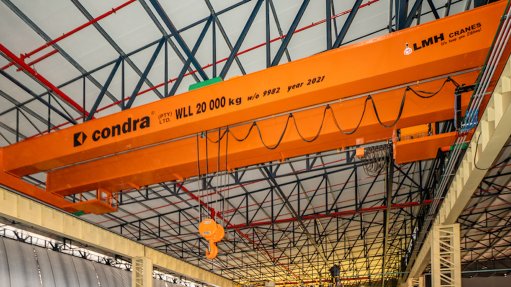
ISO-certified Condra manufactures overhead cranes, portal cranes, cantilever cranes and crane components: hoists, drives, end-carriages, brakes and...
VISIT SHOWROOM

Press Office
Announcements
What's On
Subscribe to improve your user experience...
Option 1 (equivalent of R125 a month):
Receive a weekly copy of Creamer Media's Engineering News & Mining Weekly magazine
(print copy for those in South Africa and e-magazine for those outside of South Africa)
Receive daily email newsletters
Access to full search results
Access archive of magazine back copies
Access to Projects in Progress
Access to ONE Research Report of your choice in PDF format
Option 2 (equivalent of R375 a month):
All benefits from Option 1
PLUS
Access to Creamer Media's Research Channel Africa for ALL Research Reports, in PDF format, on various industrial and mining sectors
including Electricity; Water; Energy Transition; Hydrogen; Roads, Rail and Ports; Coal; Gold; Platinum; Battery Metals; etc.
Already a subscriber?
Forgotten your password?
Receive weekly copy of Creamer Media's Engineering News & Mining Weekly magazine (print copy for those in South Africa and e-magazine for those outside of South Africa)
➕
Recieve daily email newsletters
➕
Access to full search results
➕
Access archive of magazine back copies
➕
Access to Projects in Progress
➕
Access to ONE Research Report of your choice in PDF format
RESEARCH CHANNEL AFRICA
R4500 (equivalent of R375 a month)
SUBSCRIBEAll benefits from Option 1
➕
Access to Creamer Media's Research Channel Africa for ALL Research Reports on various industrial and mining sectors, in PDF format, including on:
Electricity
➕
Water
➕
Energy Transition
➕
Hydrogen
➕
Roads, Rail and Ports
➕
Coal
➕
Gold
➕
Platinum
➕
Battery Metals
➕
etc.
Receive all benefits from Option 1 or Option 2 delivered to numerous people at your company
➕
Multiple User names and Passwords for simultaneous log-ins
➕
Intranet integration access to all in your organisation