Rail localisation study launched as public and private train operators gear up to meet 250Mt target

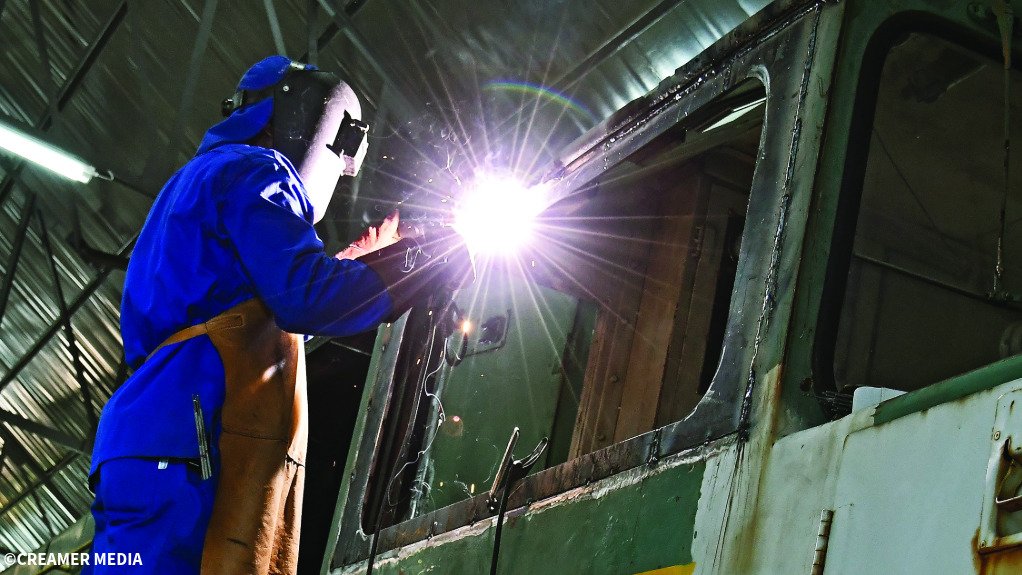


A study has been launched to assess South Africa’s existing railways manufacturing capacity and capability and to make recommendations on how policy and procurement can be leveraged to bolster localisation and transformation.
The study has been commissioned by the Localisation Support Fund (LSF) and will be conducted by Letsema Consulting over the coming six months.
It is being supported directly by the African Rail Industry Association (ARIA), which has urged its members to provide detailed inputs, as well as the Department of Trade, Industry and Competition, which has provided funding.
ARIA chairperson Anand Moodliar says the study will assess the opportunities for expanding rail localisation as both Transnet and emerging private train operating companies (TOCs) gear up to meet the target of lifting rail volumes to 250-million by 2030 from the approximately 160-million tons achieved by Transnet in 2024/25.
Moodliar, who is also CEO at the Barberry Group, one of 11 TOCs to have secured slots to operate on the Transnet network, says this will require the Transnet Freight Rail Operating Company to deliver about 185-million tons yearly and the TOCs the other 65-million tons.
To scale up to 65-million tons, the TOCs would need to invest between R30-billion and R40-billion in locomotives and wagons, which together with ongoing Transnet investment, created the potential for local industrialisation.
To deliver on the slots awarded to it, Barberry has ordered 28 of Alstom’s 23 Class electric locomotives, a model for which there is already local manufacturing, as it has also been procured by Transnet.
Moodliar also highlighted some of the local-content spin-offs relating to a R3.4-billion rolling stock investment programme by Traxtion, which has also secured slots to operate on the Transnet network.
Transnet is in the process of establishing a leasing company to supply local locomotives and wagons to the TOCs, and chief business development officer Yolisa Kani reveals that it has received interest from half of the 11 TOCs and has already signed four contracts.
Moodliar expresses confidence that this rising level of investment activity is sufficient to stimulate a supplier ecosystem supportive of localisation and transformation, while also stressing the importance of competitive supply if the industry is to recapture rail volumes from a road industry that is highly competitive.
The LSF’s Tondani Nevhutalu says there is currently more than R2.5-billion of rail equipment being imported yearly, much of which could potentially be met by domestic industry should a supportive policy and procurement framework be developed.
She reports that the study will assess aggregated demand across Transnet, the Passenger Rail Agency of South Africa and the Gautrain and evaluate local supply capabilities to meet that demand. Five workstreams will, thus, be created to study demand aggregation, supplier capability, policy instruments, procurement reforms and competitiveness.
Letsema Consulting’s Shenelle Nair says the aim will then be to identify strategic opportunities for localisation and transformation based on the demand-side mapping, the supply-side assessments, and a review of the policy instruments.
The study will also make recommendations for new policy instruments including which products and components should be designated by government for localisation and what local-content thresholds should be put in place to support industrial growth.
ARIA CEO Mesela Nhlapo says that, with the reform of the rail sector now advancing, localisation represents the next big challenge for the industry.
“Every locally produced locomotive, wagon and rail component represents livelihoods, technical skills and opportunities for artisans, engineers, technicians and small businesses across the value chain, Nhlapo asserts.
Article Enquiry
Email Article
Save Article
Feedback
To advertise email advertising@creamermedia.co.za or click here



Latest Multimedia

Latest News

Showroom
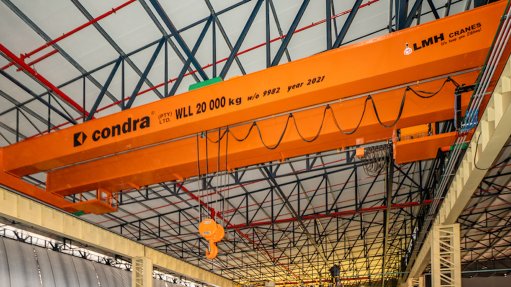
ISO-certified Condra manufactures overhead cranes, portal cranes, cantilever cranes and crane components: hoists, drives, end-carriages, brakes and...
VISIT SHOWROOM
From batteries for boats and jet skis, to batteries for cars and quad bikes, SABAT Batteries has positioned itself as the lifestyle battery of...
VISIT SHOWROOM


Press Office
Announcements
What's On
Subscribe to improve your user experience...
Option 1 (equivalent of R125 a month):
Receive a weekly copy of Creamer Media's Engineering News & Mining Weekly magazine
(print copy for those in South Africa and e-magazine for those outside of South Africa)
Receive daily email newsletters
Access to full search results
Access archive of magazine back copies
Access to Projects in Progress
Access to ONE Research Report of your choice in PDF format
Option 2 (equivalent of R375 a month):
All benefits from Option 1
PLUS
Access to Creamer Media's Research Channel Africa for ALL Research Reports, in PDF format, on various industrial and mining sectors
including Electricity; Water; Energy Transition; Hydrogen; Roads, Rail and Ports; Coal; Gold; Platinum; Battery Metals; etc.
Already a subscriber?
Forgotten your password?
Receive weekly copy of Creamer Media's Engineering News & Mining Weekly magazine (print copy for those in South Africa and e-magazine for those outside of South Africa)
➕
Recieve daily email newsletters
➕
Access to full search results
➕
Access archive of magazine back copies
➕
Access to Projects in Progress
➕
Access to ONE Research Report of your choice in PDF format
RESEARCH CHANNEL AFRICA
R4500 (equivalent of R375 a month)
SUBSCRIBEAll benefits from Option 1
➕
Access to Creamer Media's Research Channel Africa for ALL Research Reports on various industrial and mining sectors, in PDF format, including on:
Electricity
➕
Water
➕
Energy Transition
➕
Hydrogen
➕
Roads, Rail and Ports
➕
Coal
➕
Gold
➕
Platinum
➕
Battery Metals
➕
etc.
Receive all benefits from Option 1 or Option 2 delivered to numerous people at your company
➕
Multiple User names and Passwords for simultaneous log-ins
➕
Intranet integration access to all in your organisation