Highest weather station in Southern Africa installed in the Maluti-Drakensberg range

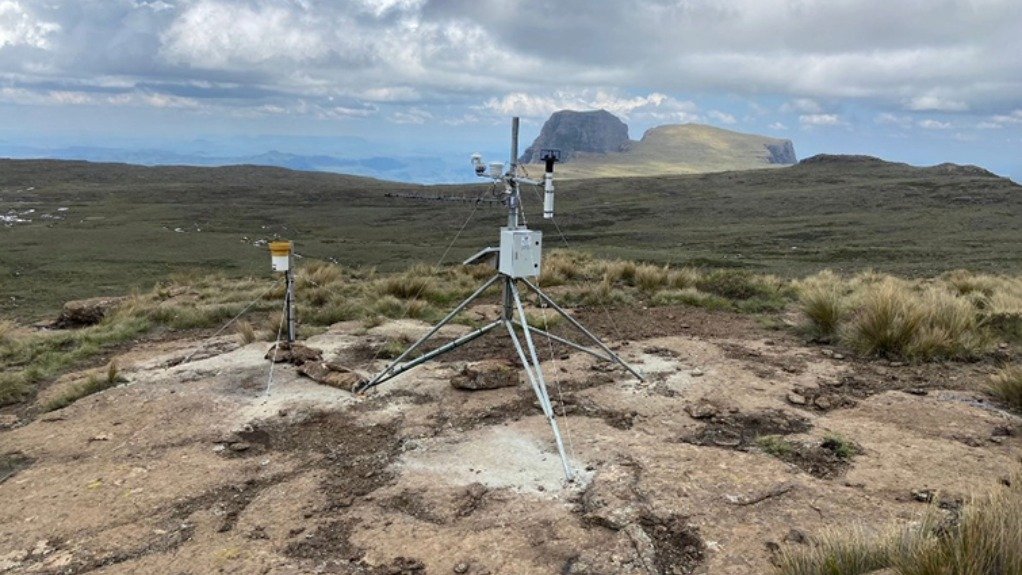


The National Research Foundation – South African Environmental Observation Network (NRF-SAEON), in collaboration with the University of the Free State’s (UFS’s) Afromontane Research Unit (ARU), has installed the highest weather station in Southern Africa in the Mont-aux-Sources area of the Maluti-Drakensberg.
Positioned atop the iconic Drakensberg Amphitheatre at 3 100 m above sea level, the automatic weather station will provide real-time climate data critical to understanding a region of exceptional biodiversity value, says the NRF.
The site encompasses key alpine and high-altitude ecosystems of the Drakensberg, which makes continuous environmental monitoring essential for research and conservation.
This strategically located station forms part of a growing network of research infrastructure being deployed across the northern Drakensberg.
The initiative is jointly implemented through NRF-SAEON’s Expanded Freshwater and Terrestrial Environmental Observation Network (EFTEON), the NRF-SAEON Grasslands Node, and the ARU.
The station records temperature, humidity, wind, incoming solar radiation, rainfall and barometric pressure.
“These continuous measurements are essential for tracking climate change, extreme weather and catchment health in real time,” says EFTEON Northern Drakensberg manager and biogeochemist Dr Kathleen Smart.
“The information will be openly available to researchers, land managers, hikers, tourism operators and anybody interested in the dynamics of this truly remarkable landscape.”
Live measurements will be available on the NRF-SAEON live weather platform, where downloadable datasets will also be hosted: https://observationsmonitor.saeon.ac.za/home.
“This station represents years of collaboration between NRF-SAEON and the ARU,” explains ARU director Professor Ralph Clark.
“It opens a window into the environmental processes that shape mountain ecosystems, which are vital for water security and biodiversity.”
The new station is one of five positioned along an altitudinal gradient stretching from the UFS’s Qwaqwa Campus, through Witsieshoek Mountain Lodge, to the alpine zone atop the Maluti-Drakensberg escarpment.
It complements existing programmes and research initiatives underway within the Mount-Aux-Sources Long-Term Socio-Ecological Research Platform (MaS-LTSER) – the only cross-border, mountain-focused LTSER platform in Africa.
Streamflow and wetland water content are monitored continuously within this open-air laboratory, which also boasts the highest research accommodation facility in Africa.
“This region is critical for several reasons,” says Professor Johan van Tol, who leads the MaS-LTSER initiative.
“It supports the livelihoods of many people in the Free State, KwaZulu-Natal, and Lesotho, many of whom depend heavily on the availability and quality of ecosystem services derived from these mountainous landscapes. At a national scale, this includes areas of agricultural importance.”
“This is a strategic water source area. It is the origin of several major rivers in South Africa, including the Orange, Tugela and Vaal systems,” adds EFTEON Northern Drakensberg instrument technician Jeremy Moonsamy, who assisted EFTEON chief instrument technician Abri de Buys in the installation of the system.
“It is, therefore, vital to monitor and understand the conditions and processes driving change in this region, including issues such as climate change, land use and land management impacts and atmospheric pollution.”
“Most of the weather networks in South Africa tend to be located in lower lying areas where most of the human activity is,” notes De Buys.
“There's a shortage of information from our high mountainous areas – the area that NRF-SAEON is now moving into.”
Article Enquiry
Email Article
Save Article
Feedback
To advertise email advertising@creamermedia.co.za or click here


Projects
Latest Multimedia

Latest News
Showroom
Leading condition monitoring specialists, WearCheck, help boost machinery lifespan and reduce catastrophic component failure through the scientific...
VISIT SHOWROOM
Sweet-Orr, established in 1871, is a global leader in superior protective workwear, known for quality, innovation, and performance.
VISIT SHOWROOM



Announcements
What's On
Subscribe to improve your user experience...
Option 1 (equivalent of R125 a month):
Receive a weekly copy of Creamer Media's Engineering News & Mining Weekly magazine
(print copy for those in South Africa and e-magazine for those outside of South Africa)
Receive daily email newsletters
Access to full search results
Access archive of magazine back copies
Access to Projects in Progress
Access to ONE Research Report of your choice in PDF format
Option 2 (equivalent of R375 a month):
All benefits from Option 1
PLUS
Access to Creamer Media's Research Channel Africa for ALL Research Reports, in PDF format, on various industrial and mining sectors
including Electricity; Water; Energy Transition; Hydrogen; Roads, Rail and Ports; Coal; Gold; Platinum; Battery Metals; etc.
Already a subscriber?
Forgotten your password?
Receive weekly copy of Creamer Media's Engineering News & Mining Weekly magazine (print copy for those in South Africa and e-magazine for those outside of South Africa)
➕
Recieve daily email newsletters
➕
Access to full search results
➕
Access archive of magazine back copies
➕
Access to Projects in Progress
➕
Access to ONE Research Report of your choice in PDF format
RESEARCH CHANNEL AFRICA
R4500 (equivalent of R375 a month)
SUBSCRIBEAll benefits from Option 1
➕
Access to Creamer Media's Research Channel Africa for ALL Research Reports on various industrial and mining sectors, in PDF format, including on:
Electricity
➕
Water
➕
Energy Transition
➕
Hydrogen
➕
Roads, Rail and Ports
➕
Coal
➕
Gold
➕
Platinum
➕
Battery Metals
➕
etc.
Receive all benefits from Option 1 or Option 2 delivered to numerous people at your company
➕
Multiple User names and Passwords for simultaneous log-ins
➕
Intranet integration access to all in your organisation