Anti-corruption efforts stagnate in SA, CW urges renewed political leadership

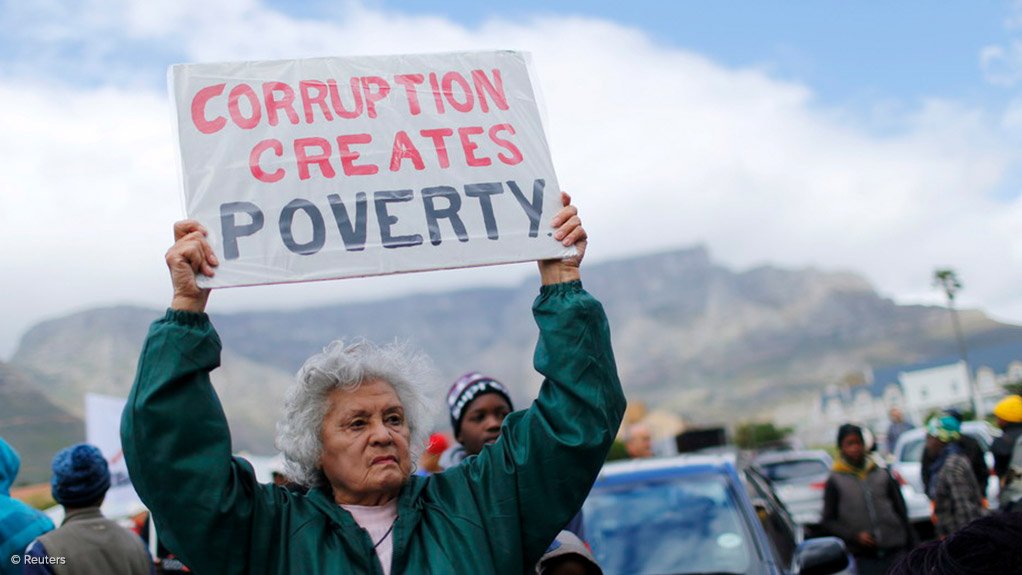


Non-profit organisation Corruption Watch (CW) on Tuesday called for renewed political leadership on anti-corruption; the protection of civic spaces with an end to attacks on journalists, whistleblowers and non-governmental organisations; and the closure of secrecy loopholes that allow corrupt money to move across borders.
Anti-corruption movement Transparency International released its 2025 Corruption Perceptions Index, highlighting worsening corruption and a decline in global leadership.
CW executive director Lebogang Ramafoko noted that the picture in South Africa was discouraging, with little to no progress shown in the last three years.
“South Africa’s anti-corruption efforts, as reflected in this year’s index, are still found wanting as the country stagnates with a score of 41, the same as in 2024, and still below the global average, despite a general decline globally for the first time in more than a decade to just 42 out of 100,” she said.
Denmark tops the overall scores on the index with a score of 89, followed by Finland with 88 and Singapore with 84.
However, encouragingly, she noting South Africa’s removal from the Financial Action Task Force grey list last year.
Ramafoko also pointed to South Africa’s successful hosting of the G20 Summit, and the Madlanga Commission of Inquiry and the Parliamentary Ad Hoc committee investigating corruption allegations within the criminal justice system.
“These developments relate to the important point that the CPI measures perceptions of corruption, not actual reports from the public, which means that sometimes recent developments are not always reflected in the report,” she said.
SUB-SAHARAN AFRICA
South Africa ranks 12 on the regional table, having fallen out of the top 10 a few years back.
The Seychelles is the region’s highest scorer with 68, followed by Cabo Verde with 62, Botswana with 58, Rwanda with 58 and Mauritius with 48. The lowest scorers include Sudan with 14, Eritrea with 13, Somalia with 9 and South Sudan with 9.
Countries classified as full democracies average 71 on the CPI, while flawed democracies average 47 and authoritarian regimes average 32.
Ramafoko noted that governments’ inability to act against corruption by introducing new laws or strengthening existing ones to combat it, impacted civil society organisations and whistleblowers speaking out against corruption freely and safely.
“…when corrupt officials and politicians continue to abuse their power, the frequent result is poor quality services and fiscal crises, as public funds are mismanaged, contributing to enduring poverty, rising inequality and worsening living standards for millions of people,” she explained.
Ramafoko pointed out that corruption pervaded public life, from parliaments and courtrooms to newsrooms, hospitals and schools.
“When public and elected officials act corruptly, they enable an environment that determines who receives justice, whose voices shape policy, which stories get told and who accesses basic services. When money or personal connections influence decisions, the State becomes a system to navigate rather than a guarantor of rights,” she said.
Corruption’s consequences spread across society and interact with other governance pressures to multiply risks and erode public trust, she warned.
Its effects are especially damaging in justice and the rule of law, democracy and political integrity, civic space and media freedom and public services and inequality.
“In each domain, corruption reshapes incentives and widens power imbalances. It is time for governments and leaders to take decisive action to turn the tide against corruption,” she said.
Article Enquiry
Email Article
Save Article
Feedback
To advertise email advertising@creamermedia.co.za or click here
Research Reports
Projects
Latest Multimedia
Latest News

Showroom
Iritron delivers advanced automation, control, and optimisation solutions to the Mining, Minerals & Metals, Consumer Package Goods and...
VISIT SHOWROOM
Columbus Stainless, based in Middelburg, Mpumalanga, is Africa’s only producer of stainless steel flat products. In addition, Columbus is the only...
VISIT SHOWROOM

Press Office
Announcements
What's On
Subscribe to improve your user experience...
Option 1 (equivalent of R125 a month):
Receive a weekly copy of Creamer Media's Engineering News & Mining Weekly magazine
(print copy for those in South Africa and e-magazine for those outside of South Africa)
Receive daily email newsletters
Access to full search results
Access archive of magazine back copies
Access to Projects in Progress
Access to ONE Research Report of your choice in PDF format
Option 2 (equivalent of R375 a month):
All benefits from Option 1
PLUS
Access to Creamer Media's Research Channel Africa for ALL Research Reports, in PDF format, on various industrial and mining sectors
including Electricity; Water; Energy Transition; Hydrogen; Roads, Rail and Ports; Coal; Gold; Platinum; Battery Metals; etc.
Already a subscriber?
Forgotten your password?
Receive weekly copy of Creamer Media's Engineering News & Mining Weekly magazine (print copy for those in South Africa and e-magazine for those outside of South Africa)
➕
Recieve daily email newsletters
➕
Access to full search results
➕
Access archive of magazine back copies
➕
Access to Projects in Progress
➕
Access to ONE Research Report of your choice in PDF format
RESEARCH CHANNEL AFRICA
R4500 (equivalent of R375 a month)
SUBSCRIBEAll benefits from Option 1
➕
Access to Creamer Media's Research Channel Africa for ALL Research Reports on various industrial and mining sectors, in PDF format, including on:
Electricity
➕
Water
➕
Energy Transition
➕
Hydrogen
➕
Roads, Rail and Ports
➕
Coal
➕
Gold
➕
Platinum
➕
Battery Metals
➕
etc.
Receive all benefits from Option 1 or Option 2 delivered to numerous people at your company
➕
Multiple User names and Passwords for simultaneous log-ins
➕
Intranet integration access to all in your organisation