Controlling carryback at conveyor transfer points

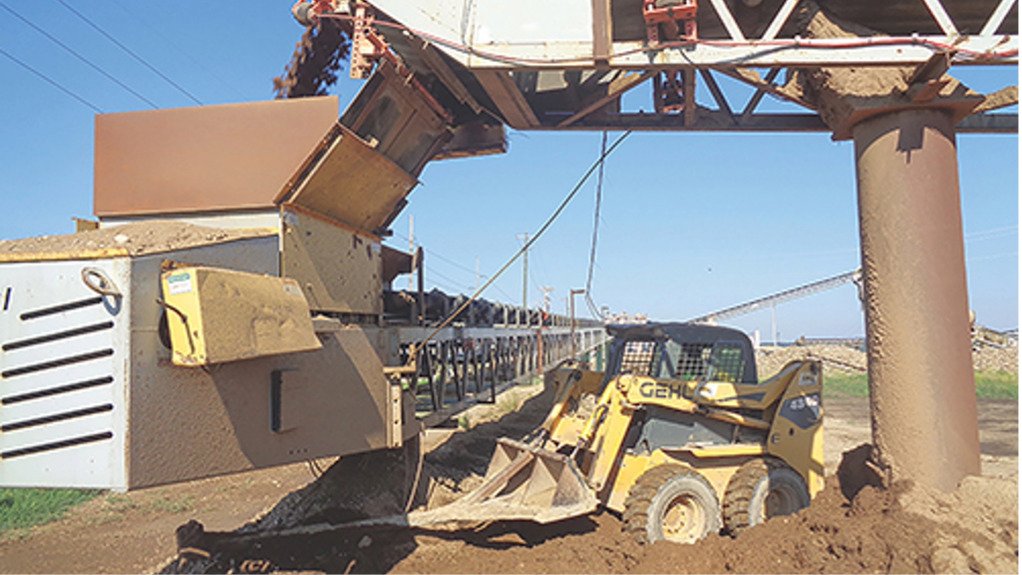
REDUCING CARRYBACK Improved belt cleaning and tracking reduce carryback, limiting spillage and dust, while improving safety and lowering operating costs


Dust and carryback from belt conveyor discharge points are an ongoing problem for bulk handling operations and the efficient discharge at a transfer point requires a holistic approach with several components working in tandem, highlights bulk material handling solutions company Martin Engineering.
This approach aims to extend equipment life, improve safety, and address the root causes of inefficiency and downtime that reduce production and raise the cost of operation, highlights Martin Engineering process engineer Dan Marshall.
Primary cleaners or “scrapers” can fail for many reasons, but usually owing to increased belt speed or material volume for which the blades are not specified, changes in material type, size or property for which the blades are not specified and difficult access that prevents regular inspection and servicing.
Other reasons include policies or schedules that allow blades to go beyond their service life, improper installation of the blade, tensioner, and and/or assembly, and inferior design or blade manufacturing materials.
When material is allowed to cling to the belt as carryback, it spills along the belt’s return. Spillage can accumulate quickly and encapsulate the belt. Cleaning spillage while the system is still running is extremely hazardous.
Marshall notes that, every year, “catastrophic” injuries or fatalities occur when workers cleaning around a running conveyor come into minor contact with a fast-moving belt and are pulled in. If equipment, such as the front-loader, is used for cleaning and bumps the mainframe, serious system misalignment can result, leading to belt mistracking. These hazards can be avoided by reducing the need for cleanup labour, which also lowers operational costs.
Mistracking can be caused by many factors, including a crosswind, off-centre loading or a frozen idler. A drifting belt can be a major cause of carryback at the discharge point if the blade is not centered on the head pulley. In this instance, adhered material bypasses the cleaner and becomes carryback.
A recommendation put forward by Marshall is to install a tracker at a location equal to three to four times the belt width before the discharge zone to ensure the belt is centered on the head pulley. He adds that clients should consider installing a modern cleaner, such as a CleanScrape Primary Belt Cleaner, which has four times the life of traditional blades and requires no retensioning or additional service after installation. This reduces maintenance and significantly improves safety.
Controlling Dust
Marshall notes that carryback is a major source of fugitive dust because much of what bypasses the primary cleaner blade is fine material hiding in belt cracks and divots. Excessive dust emissions reduce air quality and can result in workplace safety violations. It can also limit visibility, cover signage and discourage access required to maintain system health and efficiency.
“The dust and fines can also easily migrate into return rollers and takeup pulleys, fouling the bearings and causing them to seize. A frozen idler or roller increases belt friction, leading to mistracking as well as static and heat, which are major causes of belt fires. Frozen idlers and rollers must be replaced promptly, requiring unscheduled downtime, which reduces production and increases operation costs.”
Marshall suggests the installation of secondary and tertiary cleaners to ensure the belt is thoroughly clean on the return. To avoid buildup on the catch slope leading to the transfer chute, companies should consider adding a Vibrate Dribble Chute and install belt trackers or crown rolers along the lower belt path to ensure alignment on the return.
“Production increases can change throughout volumes and belt speeds, which can result in carryback, spillage, and dust. Retroactively installing equipment that improves both safety and efficiency results in reduced labour costs for maintenance, fewer equipment replacements, greater compliance, and an overall lower cost of operation,” he concludes.
Article Enquiry
Email Article
Save Article
Feedback
To advertise email advertising@creamermedia.co.za or click here
Research Reports


Projects
Latest Multimedia

Latest News
Showroom

Rentech provides renewable energy products and services to the local and selected African markets. Supplying inverters, lithium and lead-acid...
VISIT SHOWROOM
For over 15 years, Lilak Aluminium, a trusted leader in architectural extrusion supply, has delivered excellence to businesses like yours.
VISIT SHOWROOM


Press Office
Announcements
What's On
Subscribe to improve your user experience...
Option 1 (equivalent of R125 a month):
Receive a weekly copy of Creamer Media's Engineering News & Mining Weekly magazine
(print copy for those in South Africa and e-magazine for those outside of South Africa)
Receive daily email newsletters
Access to full search results
Access archive of magazine back copies
Access to Projects in Progress
Access to ONE Research Report of your choice in PDF format
Option 2 (equivalent of R375 a month):
All benefits from Option 1
PLUS
Access to Creamer Media's Research Channel Africa for ALL Research Reports, in PDF format, on various industrial and mining sectors
including Electricity; Water; Energy Transition; Hydrogen; Roads, Rail and Ports; Coal; Gold; Platinum; Battery Metals; etc.
Already a subscriber?
Forgotten your password?
Receive weekly copy of Creamer Media's Engineering News & Mining Weekly magazine (print copy for those in South Africa and e-magazine for those outside of South Africa)
➕
Recieve daily email newsletters
➕
Access to full search results
➕
Access archive of magazine back copies
➕
Access to Projects in Progress
➕
Access to ONE Research Report of your choice in PDF format
RESEARCH CHANNEL AFRICA
R4500 (equivalent of R375 a month)
SUBSCRIBEAll benefits from Option 1
➕
Access to Creamer Media's Research Channel Africa for ALL Research Reports on various industrial and mining sectors, in PDF format, including on:
Electricity
➕
Water
➕
Energy Transition
➕
Hydrogen
➕
Roads, Rail and Ports
➕
Coal
➕
Gold
➕
Platinum
➕
Battery Metals
➕
etc.
Receive all benefits from Option 1 or Option 2 delivered to numerous people at your company
➕
Multiple User names and Passwords for simultaneous log-ins
➕
Intranet integration access to all in your organisation