Fibre Circle colloquium calls for stronger partnerships to transform South Africa’s circular paper economy

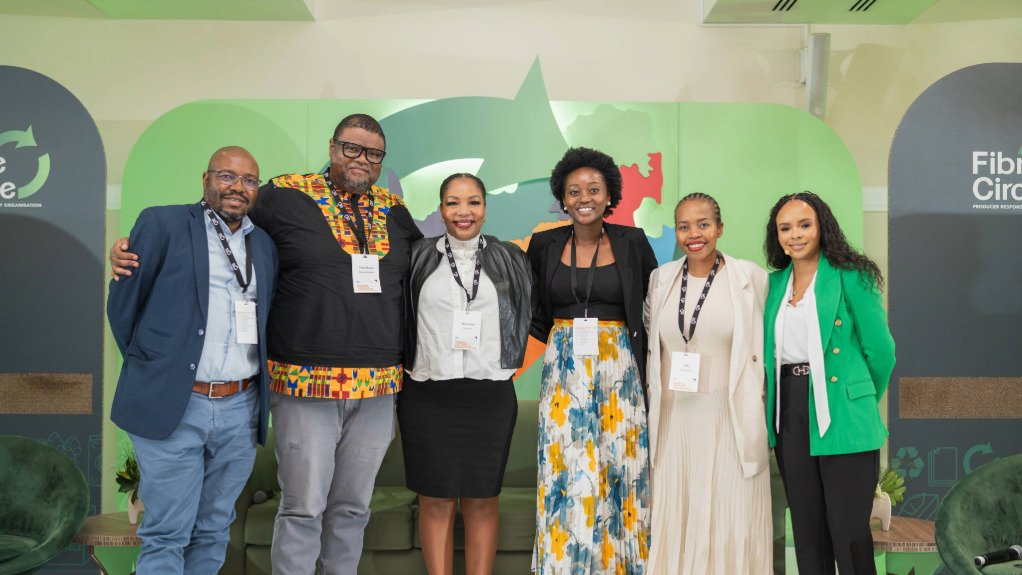
Pikitup Johannesburg GM Aluoneswi Elvis Mafunzwaini; Waste Management Bureau CEO Masopha Moshoeshoe; Fibre Circle CEO Edith Leeuta; MKGreen Solutions co-founder and CEO Phumelele Nonkala; African Reclaimers Organisation programme manager Noluthando Tutani; and moderator Nastassia Arendse



Fibre Circle, the producer responsibility organisation (PRO) for South Africa’s paper and paper packaging sector, gathered stakeholders from across the waste and recycling value chain at its recent Speaking Together Colloquium, in Johannesburg.
The goal was to focus on increasing collection and recycling rates, stimulating economic growth and finding collaborative ways to create sustainable jobs and improve waste management.
Under the theme “From Waste to Work”, the event drew representatives from government, municipalities, brand owners, packaging manufacturers, reclaimers, recyclers, small to medium-sized enterprises and academia.
Discussions centred on practical collaboration, the reclaimers’ role in material recovery and the policy and infrastructure changes needed to transform the country’s circular paper economy.
Fibre Circle CEO Edith Leeuta highlighted the importance of industry players coming together to solve industry issues.
“Our role as an institution is to be a national convener and a home where government, industry, municipalities, recyclers, investors, innovators and waste planners can come together to shape South Africa’s present and future in the circular paper economy,” said Leeuta.
“We need to solve the challenges facing the sector, but we also recognise that you can’t deal with the problem if you don’t know the size of the problem.”
Fibre Circle, in a media release, explained that this meant understanding the impact made by every cog in the value chain, so solutions were both relevant and sustainable.
Western Cape Department of Environmental Affairs and Development Planning director of waste management Pamela Nxumalo positioned the circular economy as a core development priority.
“The approach to policy about transitioning to a circular economy is increasingly recognised by government as a core determinant of economic competitiveness and sustainable growth,” she said.
“Extended producer responsibility is one of our latest policy responses and we are exploring further economic instruments and incentives to enhance the contribution of the waste sector to the circular economy.”
From a municipal perspective, Pikitup Johannesburg GM Aluoneswi Elvis Mafunzwaini outlined both progress and pressure in the city.
“We are collecting around 1.9-million tonnes of waste a year in Johannesburg and only manage to divert [from landfill] about 70 000 t. Over the last five years, we sit at roughly 22% diversion against a 40% target by 2025,” said Mafunzwaini.
“We need to ramp up diversion, strengthen separation at source and galvanise all stakeholders, which include PROs, waste reclaimers and waste pickers, if we are to protect our remaining landfill airspace and support a real circular economy.”
The African Reclaimers Organisation (ARO) brought hard data on the contribution of reclaimers working in streets and communities across South Africa, highlighting the value of the role they played and how transformative collaboration could be if it empowered reclaimers and recognised the work they do.
“In one of our projects, we tracked 945 reclaimers over 18 months and recorded 46 000 t of material collected by our members,” said ARO programme manager Noluthando Tutani.
“Reclaimers are responsible for many of the big numbers reported every month. Supporting a reclaimer pulling a bag through the suburbs is one of the most affordable and effective collection solutions the sector has.”
PARTNERSHIPS KEY
Fibre Circle said the discussions throughout the colloquium made it clear that no single part of the value chain could strengthen South Africa’s circular paper economy on its own.
It argued that manufacturers, retailers, reclaimers, municipalities, recyclers, researchers and policymakers each carried a piece of the system and real progress depended on how effectively these pieces connected.
Delegates repeatedly pointed to partnership as the foundation for better collection systems, stronger feedstock flows, reliable data, improved infrastructure and the long-term viability of recycling-led jobs and enterprises.
Fibre Circle said this collaborative approach was shaping the sector’s next phase of growth and was central to the work ahead.
When reclaimers had access to stable working spaces, manufacturers received cleaner and more consistent fibre, retailers drove demand for recycled content, and when municipalities and PROs coordinated effectively, the entire system was stronger and more effective, it argued.
The PRO added that connections translated directly into jobs, improved recovery, better data, reduced pressure on landfills and a more competitive manufacturing base.
SEPARATION AT SOURCE
The colloquium emphasised that if these partnerships were to deliver their full value, they must be matched by changes in consumer behaviour.
The sector cannot overcome contamination, littering or shrinking landfill airspace without consumers who understood the impact of their choices, argued Fibre Circle.
Industry, municipalities and reclaimers could strengthen collection systems, but the material they received still depended on how hundreds of thousands of households handled this waste at the source, it said.
“The conversation today is one step towards building a shared accountability for the outcomes we want to see, and this means collaboration and education across sectors and consumers,” says Leeuta.
Article Enquiry
Email Article
Save Article
Feedback
To advertise email advertising@creamermedia.co.za or click here
Research Reports


Projects

Latest Multimedia

Latest News

Showroom

Occupational health services, mobile clinics, wellness campaigns, aviation.
VISIT SHOWROOM
Sulzer South Africa, established in 1922, partners with critical industries like power, oil & gas, water, mining, and chemicals to boost...
VISIT SHOWROOM



Press Office
Announcements
What's On
Subscribe to improve your user experience...
Option 1 (equivalent of R125 a month):
Receive a weekly copy of Creamer Media's Engineering News & Mining Weekly magazine
(print copy for those in South Africa and e-magazine for those outside of South Africa)
Receive daily email newsletters
Access to full search results
Access archive of magazine back copies
Access to Projects in Progress
Access to ONE Research Report of your choice in PDF format
Option 2 (equivalent of R375 a month):
All benefits from Option 1
PLUS
Access to Creamer Media's Research Channel Africa for ALL Research Reports, in PDF format, on various industrial and mining sectors
including Electricity; Water; Energy Transition; Hydrogen; Roads, Rail and Ports; Coal; Gold; Platinum; Battery Metals; etc.
Already a subscriber?
Forgotten your password?
Receive weekly copy of Creamer Media's Engineering News & Mining Weekly magazine (print copy for those in South Africa and e-magazine for those outside of South Africa)
➕
Recieve daily email newsletters
➕
Access to full search results
➕
Access archive of magazine back copies
➕
Access to Projects in Progress
➕
Access to ONE Research Report of your choice in PDF format
RESEARCH CHANNEL AFRICA
R4500 (equivalent of R375 a month)
SUBSCRIBEAll benefits from Option 1
➕
Access to Creamer Media's Research Channel Africa for ALL Research Reports on various industrial and mining sectors, in PDF format, including on:
Electricity
➕
Water
➕
Energy Transition
➕
Hydrogen
➕
Roads, Rail and Ports
➕
Coal
➕
Gold
➕
Platinum
➕
Battery Metals
➕
etc.
Receive all benefits from Option 1 or Option 2 delivered to numerous people at your company
➕
Multiple User names and Passwords for simultaneous log-ins
➕
Intranet integration access to all in your organisation