Ivanhoe sets 2026, 2027 Kamoa-Kakula production guidance as dewatering progresses

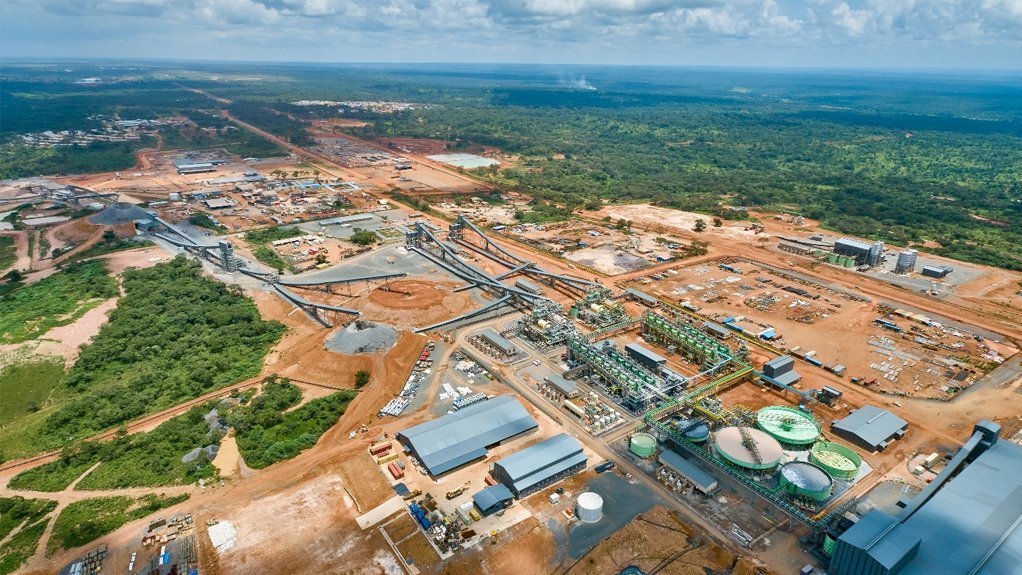


With dewatering of the Kakula mine progressing well and positive progress having been made on underground rehabilitation to date, Canadian mining company Ivanhoe Mines has set the copper production guidance for its joint venture (JV) Kamoa-Kakula complex, in the Democratic Republic of Congo (DRC), at between 380 000 t and 420 000 t for 2026 and at between 500 000 t and 540 000 t for 2027.
The company states that the complex is still targeting medium-term production of about 550 000 t/y of copper.
Dewatering of the Kakula mine is about 70% complete on the western side of the mine and 60% complete on the eastern side, Ivanhoe reports.
It adds that, to date, 13.4 km of underground workings have been rehabilitated and made safe for resumption of operations, including 4.6 km which were dewatered.
The company suspended its production guidance for the complex for 2026 and 2027 earlier this year, after seismic events in May resulted in flooding on the eastern side of the Kakula mine. A staged dewatering programme has been under way since.
“We extend our deepest gratitude to the entire team at Kamoa-Kakula for their unwavering dedication throughout the dewatering and rehabilitation of the Kakula mine. They have worked under pressure, and done so with discipline, resilience and an unshakable commitment to doing things the right way.
"Most importantly, they have carried out this demanding work with an outstanding focus on safety. Their dedication and professionalism are the foundation of our progress and we are extremely proud of their achievements,” says Ivanhoe president and CEO Marna Cloete.
“The turnaround at Kamoa-Kakula is advancing with confidence. Even during the recovery years of 2025 and 2026, this remarkable copper complex is set to produce approximately 400 000 t of copper . . . an extraordinary testament to the quality of Kamoa-Kakula’s world-leading natural endowment.
"As we move through this transition and into the next phase of growth in the coming years, Kamoa-Kakula and the Western Forelands will become one of the largest, if not the largest, copper complexes in the world. Our stakeholders are blessed with a Tier 1 mining complex that will operate for generations to come," comments Ivanhoe co-chairperson Robert Friedland.
He adds that the company is on the cusp of a transformational change for Kamoa-Kakula and the DRC as the company transitions from producing copper in concentrate in huge volumes, to producing copper anodes for sale to consumers all over the world, at its own smelter complex.
Ivanhoe earlier this week announced the start of the heat-up of the 500 000 t/y direct-to-blister copper smelter at Kamoa-Kakula, with the first feed of concentrate into the smelter expected by year-end.
Kamoa-Kakula is a JV between Ivanhoe Mines, with a 39.6% stake; Zijin Mining Group, with a 39.6% stake; Crystal River Global, owning 0.8%; and the DRC government, which holds a 20% interest in the complex.
COPPER GRADES
Ivanhoe reports that copper grades at the Kakula mine are improving as dewatering activities reopen higher-grade mining areas. A revised mine design has also been developed based on geotechnical expert guidance, including new pillar designs and extraction sequencing.
Mining rates on the western side of Kakula have increased to an average rate of 350 000 t a month, equivalent to 4.2-million tonnes annualised.
Mining activities have been focused on higher-elevation areas in the north and south-west, where copper grades are lower than those of the higher-grade centre section. As water levels on the western side recede, mining crews are advancing towards the high-grade centre section, where grades increase to between 3.5% and 4% from mid-December.
Mining rates at Kakula are expected to improve gradually throughout 2026. Selective mining within the existing workings on the eastern side of the Kakula mine is expected to start in the first quarter of 2026, augmenting rising production rates from higher-grade areas on Kakula’s western side.
This is expected to increase production rates to 450 000 t a month, or 5.5-million tonnes a year annualised, by the end of the quarter.
In addition, underground development towards a new mining area further to the east is expected to begin mining ore from mid-year 2026.
Ivanhoe expects that about six-million tonnes of ore will be mined at Kakula during 2026. That will increase further to between seven-million and eight-million tonnes in 2027.
Grades are expected to range from 3.5% to 4.5% during this period. About 70% of the ore will be sourced from the western side of the Kakula mine during 2026, which will reduce during 2027 as new mining areas on the eastern side are opened up.
All ore mined from the Kakula mine will be processed by the Phase 1 and 2 concentrators.
KAMOA MINING RATES
Ivanhoe notes that the mining rate of the Kamoa mines – Kamoa 1, Kamoa 2 and Kansoko underground – is targeted to increase from about 6.5-million tonnes currently, to about 8.5-million tonnes in 2026 and to over ten-million tonnes in 2027.
Grades from the Kamoa mines are expected to average about 2.5% during this period.
The increased mining rate will enable the Kamoa mine to feed the Phase 3 concentrator and provide supplementary feed to the phase 1 and 2 concentrators.
The phase 1 and 2 concentrators will continue to process ore from the western side of the Kakula mine and surface stockpiles until the first quarter of 2026 when the stockpiles are depleted.
In addition, from the first quarter of next year, the phase 1 and 2 concentrators will be supplemented with an increasing quantity of ore from the eastern side of Kakula, as well as ore trammed from Kamoa.
Ivanhoe states that about two-million tonnes of ore from Kamoa is expected to be processed by the phase 1 and 2 concentrators in 2026, increasing to 2.5-million tonnes in 2027.
The phase 1 and 2 concentrators have demonstrated combined operating capacity of 10.5-million tonnes a year since various de-bottlenecking activities were completed.
The Phase 3 concentrator will continue to process at a rate of 6.5-million tonnes a year, which has also been demonstrated over many months of operations, fed by the Kamoa mines, the company points out.
Article Enquiry
Email Article
Save Article
Feedback
To advertise email advertising@creamermedia.co.za or click here

Projects
Latest Multimedia
Latest News
Showroom
AxFlow AQS Liquid Transfer (Pty) Ltd is an Importer and Distributor of Pumps in Southern Africa
VISIT SHOWROOM
The SAIMM started as a learned society in 1894 after the invention of the cyanide process that saved the South African gold mining industry of the...
VISIT SHOWROOM


Press Office
Announcements
What's On
Subscribe to improve your user experience...
Option 1 (equivalent of R125 a month):
Receive a weekly copy of Creamer Media's Engineering News & Mining Weekly magazine
(print copy for those in South Africa and e-magazine for those outside of South Africa)
Receive daily email newsletters
Access to full search results
Access archive of magazine back copies
Access to Projects in Progress
Access to ONE Research Report of your choice in PDF format
Option 2 (equivalent of R375 a month):
All benefits from Option 1
PLUS
Access to Creamer Media's Research Channel Africa for ALL Research Reports, in PDF format, on various industrial and mining sectors
including Electricity; Water; Energy Transition; Hydrogen; Roads, Rail and Ports; Coal; Gold; Platinum; Battery Metals; etc.
Already a subscriber?
Forgotten your password?
Receive weekly copy of Creamer Media's Engineering News & Mining Weekly magazine (print copy for those in South Africa and e-magazine for those outside of South Africa)
➕
Recieve daily email newsletters
➕
Access to full search results
➕
Access archive of magazine back copies
➕
Access to Projects in Progress
➕
Access to ONE Research Report of your choice in PDF format
RESEARCH CHANNEL AFRICA
R4500 (equivalent of R375 a month)
SUBSCRIBEAll benefits from Option 1
➕
Access to Creamer Media's Research Channel Africa for ALL Research Reports on various industrial and mining sectors, in PDF format, including on:
Electricity
➕
Water
➕
Energy Transition
➕
Hydrogen
➕
Roads, Rail and Ports
➕
Coal
➕
Gold
➕
Platinum
➕
Battery Metals
➕
etc.
Receive all benefits from Option 1 or Option 2 delivered to numerous people at your company
➕
Multiple User names and Passwords for simultaneous log-ins
➕
Intranet integration access to all in your organisation