Symbol of floods now gone


Last week, Rosita Salvador Mubiango breathed her last in a rural southern Mozambican hospital where she had been admitted for weeks, her young life cruelly snuffed out by a blood disorder she had battled for a long time. Mention of her name beyond Chibuto district would likely have elicited a “Rosita who?” and her death was largely unnoticed by the wider world.
But this quiet departure from the land of the living stands in sharp contrast to her very public arrival in February 2000. That month, the Limpopo river burst its banks in southern Mozambique. Hundreds died; hundreds of thousands were forced from their homes.
Rosita’s family was one of countless others caught up in the crisis. The Red Cross Society quoted her at the time: “It was Sunday afternoon at about four o’clock, and the waters began rising. The water was coming right up to the house, and was getting stronger and stronger, so, like everyone else in the village, we headed for the trees. I put my two children on my back and tried to climb up.”
She and other villagers remained perched in the trees for days, praying for divine intervention. Then she went into labour and gave birth to Rosita. Shortly afterwards, mother and child were spotted by a South African military helicopter that was assisting in rescue operations. Images of their rescue, captured by newspapers and television channels, captivated the entire world.
The two became symbols of the aftermath of the floods and travelled to the US later that year to address Congress, raising awareness about what had happened.
But that moment is no longer an isolated symbol; it is now emblematic of how climate change has made weather extremes a relentless reality for millions in Southern Africa and beyond.
Mozambique – Rosita’s motherland – has been among the hardest hit in the region, recording 16 named tropical cyclones and storms with severe impacts from 2005 to 2023. The most notable of these events – which are no longer infrequent anomalies but near-annual occurrences – is Cyclone Idai, which struck in 2019 and has been described as one of the worst ever in the southern hemisphere. The housing and infrastructure damage it wrought has not been addressed in all affected communities, especially those outside the main impact area along the Indian Ocean coast.
Idai’s fury was not confined to Mozambique. Malawi and Zimbabwe were also battered, with more than 1 000 lives lost across the three countries and 2.6-million people left in desperate need of humanitarian assistance.
Barely six weeks after Idai, Cyclone Kenneth made landfall, delivering an unprecedented back-to-back cyclone strike.
South Africa has also faced its fair share of extreme weather events in recent years. The most severe were the floods in KwaZulu-Natal in 2022 and the Eastern Cape in 2025. The KwaZulu-Natal floods, triggered by prolonged heavy rains in Durban and surrounding areas, claimed more than 400 lives and caused extensive infrastructure damage. The Eastern Cape floods caused about 100 deaths.
Disaster tracking data shows that Mozambique and South Africa suffered 55 and 54 climate-related disaster events respectively in the two decades leading up to 2019, tallies surpassed only by Kenya, with 60 recorded events.
Clearly, this situation demands a redoubling of efforts. Rich countries, the greatest contributors to climate change, must adopt ambitious, binding emissions reduction targets aligned with keeping global warming below 1.5 ºC. While the long-term average is still below this threshold, some recent individual years – such as 2024 – have already surpassed it. Without drastic cuts, there is a 70% to 86% likelihood that global temperatures will exceed 1.5 ºC for one or even a five-year period between 2025 and 2029, according to the World Meteorological Organisation.
Significant investment is urgently needed to establish or scale up early-warning systems, climate-resilient infrastructure, and climate-smart agriculture. Rich countries must bear the primary responsibility for the funding because their emissions fuelled the climate crisis now ravaging Africa, while multilateral bodies must shift from debt-driven responses to grant-based support. For their part, African governments must ensure investments reach vulnerable communities through transparent, accountable systems.
Finally, African voices, like Rosita’s mother, who once addressed the US Congress, must be more prominent in the climate discourse.
Article Enquiry
Email Article
Save Article
Feedback
To advertise email advertising@creamermedia.co.za or click here
Research Reports

Projects
Latest Multimedia
Showroom

For over 60 years, VEGA has provided industry-leading products for the measurement of level, density, weight and pressure. As the inventor of the...
VISIT SHOWROOM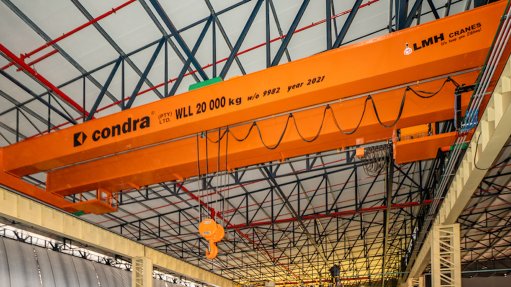
ISO-certified Condra manufactures overhead cranes, portal cranes, cantilever cranes and crane components: hoists, drives, end-carriages, brakes and...
VISIT SHOWROOM

Announcements
What's On
Subscribe to improve your user experience...
Option 1 (equivalent of R125 a month):
Receive a weekly copy of Creamer Media's Engineering News & Mining Weekly magazine
(print copy for those in South Africa and e-magazine for those outside of South Africa)
Receive daily email newsletters
Access to full search results
Access archive of magazine back copies
Access to Projects in Progress
Access to ONE Research Report of your choice in PDF format
Option 2 (equivalent of R375 a month):
All benefits from Option 1
PLUS
Access to Creamer Media's Research Channel Africa for ALL Research Reports, in PDF format, on various industrial and mining sectors
including Electricity; Water; Energy Transition; Hydrogen; Roads, Rail and Ports; Coal; Gold; Platinum; Battery Metals; etc.
Already a subscriber?
Forgotten your password?
Receive weekly copy of Creamer Media's Engineering News & Mining Weekly magazine (print copy for those in South Africa and e-magazine for those outside of South Africa)
➕
Recieve daily email newsletters
➕
Access to full search results
➕
Access archive of magazine back copies
➕
Access to Projects in Progress
➕
Access to ONE Research Report of your choice in PDF format
RESEARCH CHANNEL AFRICA
R4500 (equivalent of R375 a month)
SUBSCRIBEAll benefits from Option 1
➕
Access to Creamer Media's Research Channel Africa for ALL Research Reports on various industrial and mining sectors, in PDF format, including on:
Electricity
➕
Water
➕
Energy Transition
➕
Hydrogen
➕
Roads, Rail and Ports
➕
Coal
➕
Gold
➕
Platinum
➕
Battery Metals
➕
etc.
Receive all benefits from Option 1 or Option 2 delivered to numerous people at your company
➕
Multiple User names and Passwords for simultaneous log-ins
➕
Intranet integration access to all in your organisation