When luxury isn’t luxury


Spoiler alert: you have missed the deadline for what follows, but, in my humble opinion, it was always a challenging deadline. A ten-working-day deadline was given to propose 2026 technical tax proposals.
That said, what follows is not a history lesson, but rather a call to action – if you still want to contribute. While you contemplate whether to continue reading or contribute, let me share my opinion on what I believe the National Treasury should consider, from a customs and excises perspective, for its ‘Budget Tax Proposals 2026’.
Before getting to that, would it not be a fair assumption that you have not read past ‘Budget Tax Proposals’? After, or rather once, the Finance Minister starts delivering the National Budget in Parliament, you can access the National Budget documentation, along with the ‘Budget Review’, a document that is roughly 230 pages. Within its pages, towards the end, you will find ‘Annexure C: Additional Tax Policy and Administrative Adjustments’, featuring this opening paragraph: “This annexure should be read with Chapter 4 of the Budget Review. It elaborates on some of the proposals contained in the chapter, clarifies certain matters, and presents additional technical proposals arising from the annual tax policy process.”
Then, under the header ‘Customs and Excise Duty’, the document states: “Government proposes that excise duties in the Customs and Excise Act (1964, Section A of Part 2 of Schedule 1) be amended with effect from 12 March 2025 to the extent shown in Table C.4.”
In essence, this refers to the ‘sin taxes’ – “Specific excise duties on locally manufactured or imported goods of the same class or kind”. In case you were wondering, there is a Section B of part of Schedule 1 for ‘luxury taxes’ – “Ad valorem excise duties on locally manufactured goods or imported goods of the same class or kind.”
What follows is the heading ‘Additional Policy and Administrative Amendments’. Under the first subheading, ‘Tax administration’, you will find ‘Customs and Excise Act’. In 2025, there were seven administrative amendments: delegation of functions of customs officers and designation of persons as customs officers; customs voluntary disclosure programme; timing of adjustment of bill of entry; body-worn cameras; diesel refund; dutiability of waste derived from processing imported goods in manufacturing plants; and movement of fuel products.
In 2024, there were three: reviewing the process for packages imported through e-commerce; the timeframe for the delivery of export bills of entry; and simplifying the process for substituting bills of entry in certain circumstances.
In 2023, there were four: specifying conditions for the deferment of duties; single window for advance passenger information and passenger number record data; traveller management system; and amending the processes and procedures for provisional payments.
In 2022, there were four: advance rulings under the Customs and Excise Act; time of entry for break-bulk cargo imported by sea, air and rail; clarifying the requirements for invoices in respect of import and export goods; and progress with the review of the diesel refund administration.
What strikes me as odd is why no changes are being made to ‘luxury taxes’. Why are they not abolished in their entirety, or, at the very least, significantly restructured? Are they still fit for purpose? I believe not.
In your assessment, consider a generic definition of ‘luxury goods’, which are “high-quality, expensive items that are not essential for survival but serve as symbols of status and wealth within society”.
The primary reason for arguing for a significant restructuring, at the very least, is that the goods in question no longer represent goods that could rightly be classified as ‘luxury goods’. Would you consider the following to be ‘luxury goods’: fireworks, articles of fur skin and artificial fur skin, air conditioners, computers, landline telephones, cellphones, loudspeakers, videorecording apparatus, video camera recorders, cathode-ray tube monitors, televisions (including black and white), muzzle-loading firearms, articles for funfair, table or parlour games, and my personal favourite, golf balls? In case you were wondering, golf clubs are seemingly not considered ‘luxury goods’.
Should you want to study the ‘luxury goods’ schedule at your own leisure, please visit:
https://www.sars.gov.za/wp-content/uploads/Legal/SCEA1964/Legal-LPrim-CE-Sch1P2B-Schedule-No-1-Part-2B.pdf
Article Enquiry
Email Article
Save Article
Feedback
To advertise email advertising@creamermedia.co.za or click here


Projects

Latest Multimedia


Latest News


Showroom

AirNox (Pty) Ltd is a level 1 BBBEE manufacturer of complete AdBlue® solutions for operators of SCR diesel engines and AUS40 across South Africa...
VISIT SHOWROOM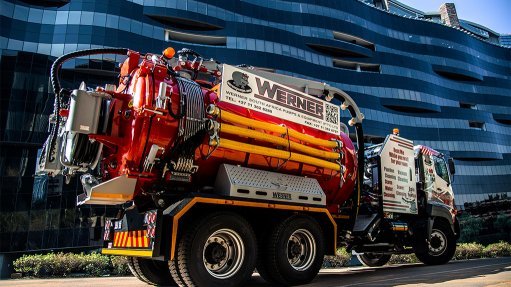
For over 30 years, Werner South Africa Pumps & Equipment (PTY) LTD has been designing, manufacturing, supplying and maintaining specialist...
VISIT SHOWROOM



Press Office
Announcements
What's On
Subscribe to improve your user experience...
Option 1 (equivalent of R125 a month):
Receive a weekly copy of Creamer Media's Engineering News & Mining Weekly magazine
(print copy for those in South Africa and e-magazine for those outside of South Africa)
Receive daily email newsletters
Access to full search results
Access archive of magazine back copies
Access to Projects in Progress
Access to ONE Research Report of your choice in PDF format
Option 2 (equivalent of R375 a month):
All benefits from Option 1
PLUS
Access to Creamer Media's Research Channel Africa for ALL Research Reports, in PDF format, on various industrial and mining sectors
including Electricity; Water; Energy Transition; Hydrogen; Roads, Rail and Ports; Coal; Gold; Platinum; Battery Metals; etc.
Already a subscriber?
Forgotten your password?
Receive weekly copy of Creamer Media's Engineering News & Mining Weekly magazine (print copy for those in South Africa and e-magazine for those outside of South Africa)
➕
Recieve daily email newsletters
➕
Access to full search results
➕
Access archive of magazine back copies
➕
Access to Projects in Progress
➕
Access to ONE Research Report of your choice in PDF format
RESEARCH CHANNEL AFRICA
R4500 (equivalent of R375 a month)
SUBSCRIBEAll benefits from Option 1
➕
Access to Creamer Media's Research Channel Africa for ALL Research Reports on various industrial and mining sectors, in PDF format, including on:
Electricity
➕
Water
➕
Energy Transition
➕
Hydrogen
➕
Roads, Rail and Ports
➕
Coal
➕
Gold
➕
Platinum
➕
Battery Metals
➕
etc.
Receive all benefits from Option 1 or Option 2 delivered to numerous people at your company
➕
Multiple User names and Passwords for simultaneous log-ins
➕
Intranet integration access to all in your organisation