Sansa warns of impending geomagnetic storm

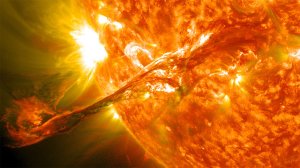


The Department of Science, Technology and Innovation, together with the South African National Space Agency (Sansa), has advised that geomagnetic storm conditions will likely increase over the next 24 hours with the arrival of an Earth-directed coronal mass ejection (CME).
The CME was triggered by a long duration X1.9 solar flare event on January 18.
A solar flare is a sudden burst of light from the sun with an immediate impact on the Earth’s day side, disrupting high frequency radio communications.
Solar flares are ranked in five categories — A, B, C, M and X — based on their intensity.
A-class flares are the weakest, while X-class flares are the most energetic.
The Africa region was not affected by the high-frequency radio blackout on January 18 as it was observed during nighttime, mostly out of the flare’s impact range.
However, the solar flare triggered a CME, which is a cloud of plasma released from the sun.
This CME is currently travelling from the sun to the Earth and is expected to impact Earth from the early hours of January 20.
This impact will interact with the Earth’s magnetic field and cause a geomagnetic storm. The geomagnetic storm could reach G4 or severe storm conditions.
The G-scale, used by space weather centres globally, categorises geomagnetic storms based on their intensity and potential impact. It ranges from G1 (minor), G2 (moderate), G3 (strong), G4 (severe) and G5 (extreme).
Sansa’s Space Weather Centre expects geomagnetic conditions to increase over the next 24 hours. Unlike terrestrial storms, geomagnetic storms largely go unnoticed by people because their effects are felt mainly through technological systems.
Navigation, communication and electricity networks are the most at risk.
Industries such as aviation and drone operations can be affected by the impact on navigation systems and should take note of the K-Index, a standardised, global measure of geomagnetic activity, showing how much the Earth's magnetic field is disturbed.
Sansa operates a local K-Index from Hermanus that can be tracked at spaceweather.sansa.org.za.
Article Enquiry
Email Article
Save Article
Feedback
To advertise email advertising@creamermedia.co.za or click here

Projects
Latest Multimedia
Latest News

Showroom

The Beneficiation Academy is a certified training institution that follows all compliance legislation and is accredited with various Sector...
VISIT SHOWROOM
Smart energy storage solutions for efficient, safe, and profitable power.
VISIT SHOWROOM



Press Office
Announcements
What's On
Subscribe to improve your user experience...
Option 1 (equivalent of R125 a month):
Receive a weekly copy of Creamer Media's Engineering News & Mining Weekly magazine
(print copy for those in South Africa and e-magazine for those outside of South Africa)
Receive daily email newsletters
Access to full search results
Access archive of magazine back copies
Access to Projects in Progress
Access to ONE Research Report of your choice in PDF format
Option 2 (equivalent of R375 a month):
All benefits from Option 1
PLUS
Access to Creamer Media's Research Channel Africa for ALL Research Reports, in PDF format, on various industrial and mining sectors
including Electricity; Water; Energy Transition; Hydrogen; Roads, Rail and Ports; Coal; Gold; Platinum; Battery Metals; etc.
Already a subscriber?
Forgotten your password?
Receive weekly copy of Creamer Media's Engineering News & Mining Weekly magazine (print copy for those in South Africa and e-magazine for those outside of South Africa)
➕
Recieve daily email newsletters
➕
Access to full search results
➕
Access archive of magazine back copies
➕
Access to Projects in Progress
➕
Access to ONE Research Report of your choice in PDF format
RESEARCH CHANNEL AFRICA
R4500 (equivalent of R375 a month)
SUBSCRIBEAll benefits from Option 1
➕
Access to Creamer Media's Research Channel Africa for ALL Research Reports on various industrial and mining sectors, in PDF format, including on:
Electricity
➕
Water
➕
Energy Transition
➕
Hydrogen
➕
Roads, Rail and Ports
➕
Coal
➕
Gold
➕
Platinum
➕
Battery Metals
➕
etc.
Receive all benefits from Option 1 or Option 2 delivered to numerous people at your company
➕
Multiple User names and Passwords for simultaneous log-ins
➕
Intranet integration access to all in your organisation